
Arsenal’s parade route traces centuries of Islington history
Inspired by Arsenal’s historic achievements in 2026, this blog post looks at the origins of the streets on its trophy parade route.

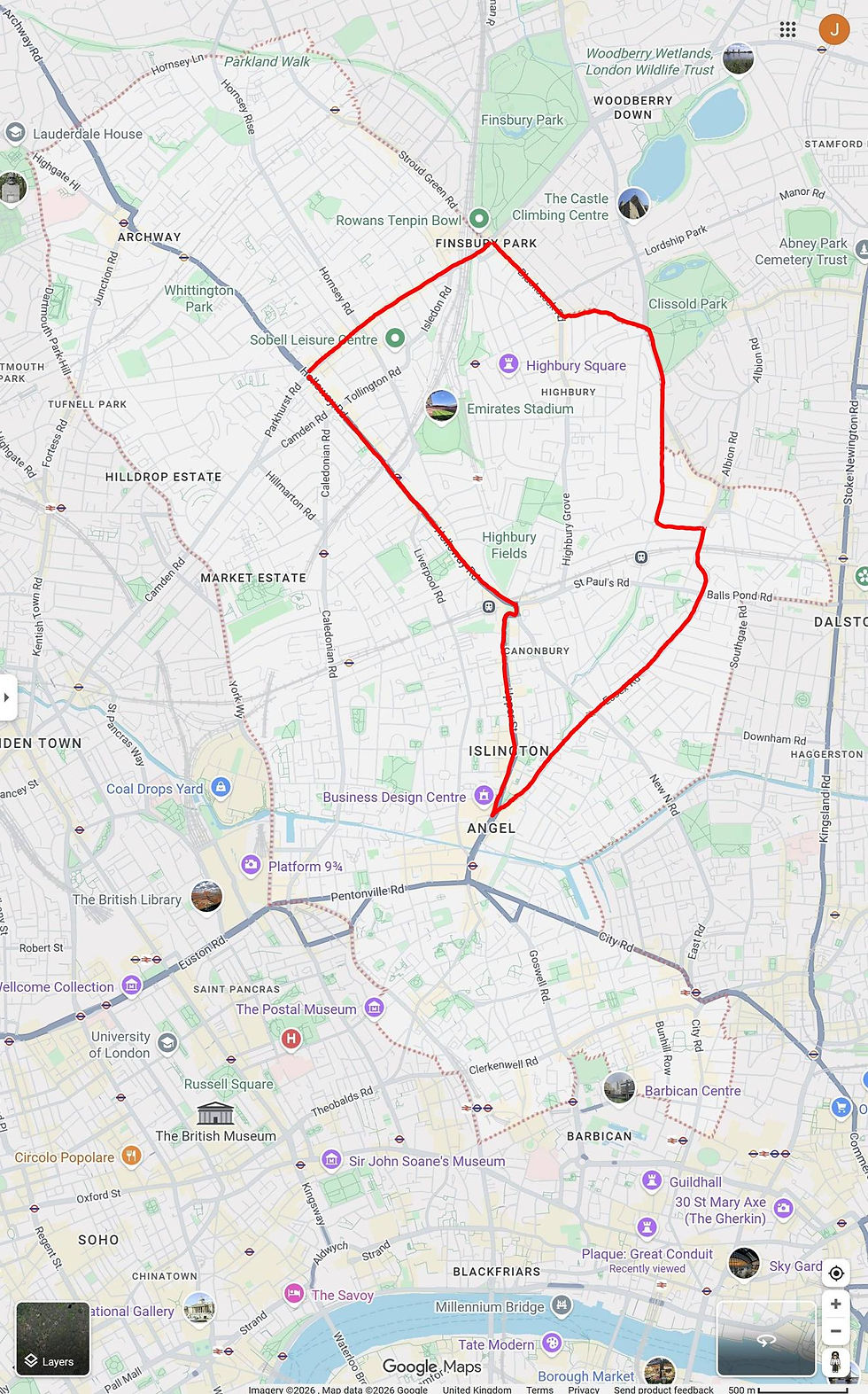
Arsenal Football Club will be parading in four open top buses around Islington on 31 May 2026 to celebrate the men’s team’s clinching of its first Premier League title since 2004 and the women’s team’s victory in the FIFA Women’s Champions Cup. The men’s team may also be celebrating a UEFA Champions League win if they beat Paris St Germain on 30 May (but, regardless of the result of that game, there will be plenty to cheer).
Walks available for booking
For a schedule of forthcoming London On The Ground guided walks and tours, please click here.
The circular parade route will be longer than in the past and it will not stop, to allow more people to see it safely. It is scheduled to start at 2pm and Arsenal estimates it will take two hours.

The route starts, and ends, at a point on Holloway Road close to the Arsenal stadium and traces a clockwise loop within the London Borough of Islington, which has been home to Arsenal since 1913 (although part of the route skirts along the border between Islington and Hackney). It takes in only two streets in their entirety, Mountgrove Road and Essex Road.
Today Islington is the most densely populated local authority in England, but it was a rural village outside London until rapid urbanisation swallowed it in the 19th century. Until then, the built-up area was mainly limited to Upper Street and Essex Road. Much of the rest of today’s Islington was fields for grazing cattle and other farm animals.
The map below shows Arsenal’s 2026 parade route super-imposed on a section of John Rocque’s London 10 Miles Round map of 1746.

What follows is a brief run through the origin of the names of the streets that will host the Arsenal parade, together with some snippets of the history of the area. It includes a surprising number of references to the New River, a conduit built in 1609-1613 to bring fresh water from Hertfordshire into London, and which flowed through rural Islington to a reservoir at New River Head (the site is next to Sadler's Wells Theatre), off Roseberry Avenue.
Holloway Road
Holloway Road was part of the Great North Road, which ran from the City of London to York and Edinburgh. The name derives from the ‘hollow way’ created by centuries of travellers - by foot, cart and coach - and animals, many of which were heading to the livestock market at Smithfield.

Seven Sisters Road
The name of this street is thought to derive from seven ancient elm trees encircling a walnut tree at Page Green, at the other end of Seven Sisters Road in (say it quietly) Tottenham. Although tracks ran through the fields along part of its route for many centuries, the road was constructed in the 1830s. It ran to Page Green from Regent’s Park (where that section of the road is now Parkway).
Blackstock Road
The New River once ran in a wooden aqueduct along a part of Blackstock Road, previously also known as Boarded River Lane, Danebottom Lane and Highbury Vale. The current name, which dates to the 19th century, is said to refer to the blackstock hedgerows that lines this former country lane.
Blackstock Road runs along the boundary of the London Boroughs of Islington and Hackney.
Mountgrove Road
First laid out in the mid 19th century and renamed from Gypsey Lane in 1870, Mountgrove Road also lies on the Islington/Hackney border. The name may refer to the gradient of the land here. The New River once crossed Mountgrove Road at its western end (at the junction with Blackstock Road) and also flowed along its eastern end.
When I lived in a house on Mountgrove Road in the 1990s, I could see the top of the old North Bank stand at Arsenal’s old stadium from the first floor windows.
Riversdale Road
From Mountgrove Road, the New River ran along Riversdale Road at its eastern end (presumably the origin of its name), a path still followed here by the border between Islington and Hackney.
Green Lanes
Green Lanes runs from Newington Green all the way to Winchmore Hill, although its name changes to High Road as it passes through Wood Green. Its name refers to its long history as a drovers’ route, possibly going back to Roman times.
Clissold Park, probably a good place from which to see the Arsenal parade, is in Hackney. The park was once the grounds of a country house built in 1793. It is named after Augustus Clissold, husband of Eliza Crawshaw, whose father William bought the estate in around 1811. The park opened to the public in 1889.

Petherton Road
After looping through Clissold Park, the New River turned south along what later became Petherton Road, which explains why the street is so wide. The narrow park in the middle the road is where the waterway once flowed.
In the 1990s, I moved from Mountgrove Road to live in Petherton Road. I was unknowingly following part of the former path of the New River and part of the future route of the 2026 Arsenal parade.

Beresford Road
Beresford Road was completed in 1871, part of a major new development of streets carried out by Henry Rydon. In under 20 years, the area changed from rural to brickfields to fully urban. I am not sure where the name Beresford comes from.
Newington Green Road
This road runs through the area known as Newington Green, which is also the name of the open space at the north end of the road.
‘Newington’ means ‘new town’ and the area is recorded in the 1086 Domesday Book as ‘Neutone’. The green originated as a forest clearing, where cottages stood in the 15th century. Henry VIII is said to have had a hunting lodge here, and also to have housed his mistresses nearby. Five houses on the west side of Newington Green date from c.1658.
Newington Green Road was a rural lane until the mid 19th century, although there are three cottages from the 1790s on the east side of the road at the junction with Bingham Street.


Ellen ‘Nelly’ Ternan was living in Park Cottage, very near here, when Charles Dickens first met her in 1857 (see What the Dickens? In Islington? Not on your Nelly!).
Essex Road
As the parade enters Essex Road, it will pass the former St Paul’s church, one of four churches in Islington designed by Charles Barry (who later designed the Houses of Parliament).
Originally called Lower Street, Lower Road and (at its northeastern end) Newington Green Lane, this street has been known as Essex Road since 1864. The name may refer to the Earl of Essex, once a favourite of Elizabeth I, who may have had a house here, or because it leads towards Essex.
The New River used to flow in a tunnel under Essex Road, going underground where the South Library is today and re-emerging at the north end of Colebrook Row.

The names Lower Street/Lower Road refer to its position downhill from Upper Street, which Essex Road meets at Islington Green.
On its way down Essex Road, the parade will pass the site of a lost Victorian cattle market, the entrance to Britannia Row (where Pink Floyd once had a studio and at the bottom of which the bell ringers of St James' Church will be ringing in celebration of Arsenal at 4pm on 31 May) and the historic Queen’s Head pub.
Islington Green
Islington Green is a surviving piece of common land, where locals had free grazing rights. There used to be a watch house, for locking up drunks and petty offenders, where the statue of Hugh Myddelton now stands. Carved in 1862 by the wonderfully named John Thomas, the statue commemorates the driving force behind the New River, the construction of which he oversaw from 1609-1613.

Upper Street
For centuries Upper Street has been Islington’s main road. Running along a ridge, which explains its name, it formed part of the main route for drovers bringing livestock into Smithfield Market. Charles Dickens said it was "amongst the noisiest and most disagreeable thoroughfares in London"
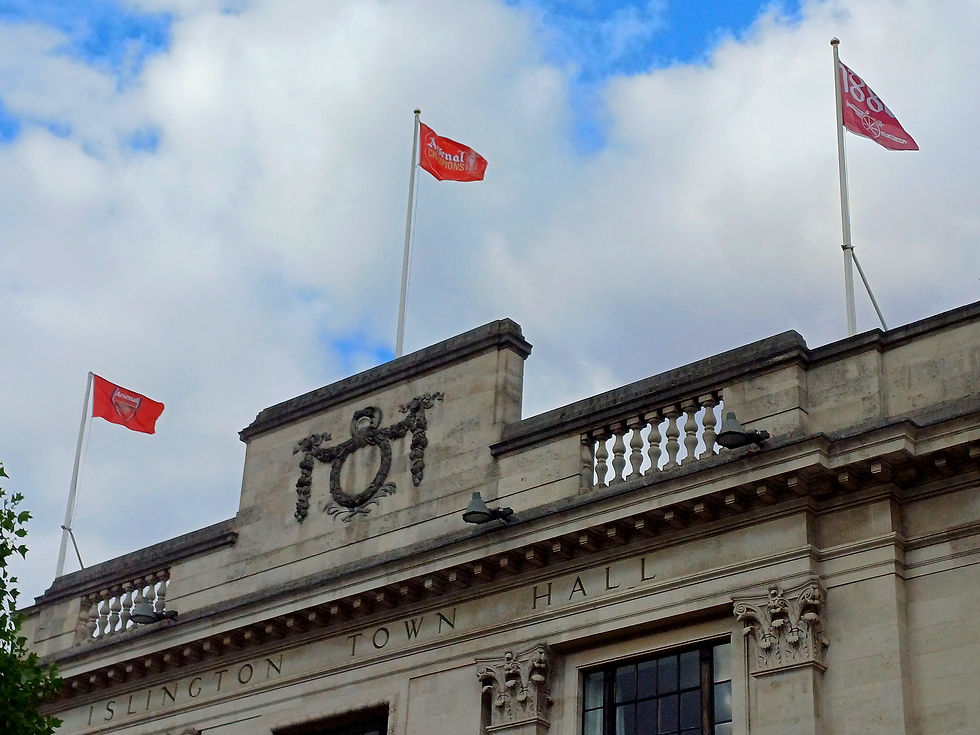
As it travels north along Upper Street, the parade route will pass by The Almeida, Islington’s world renowned local theatre, Islington’s oldest church, St Mary Islington, and Islington Town Hall, which used to be the destination for Arsenal victory parades in times gone by.

Highbury Corner
The Highbury area’s name refers to its location on a hill, where the Order of St John, also known as the Knights Hospitaller, had a manor house from the 13th century. Highbury Corner is at the junction of Upper Street, Holloway Road and St Paul’s Road (once known as Hopping Lane).
A devastating aerial bombing raid struck Highbury Corner on 27 June 1944, when a V-1 flying bomb, also known as a Doodle Bug, killed 28 people and injured 150 more. It also destroyed the houses at the northern end of Compton Terrace, effectively enlarging the space of Highbury Corner ever since.
This is also the location of Highbury and Islington station, one of the main points of entry/exit to/from the London transport network for residents and Arsenal fans at home games. Sadly, the magnificent station of 1872, by Edwin Henry Horne, was damaged by the 1944 bomb and demolished in the 1960s.

From Highbury Corner, the parade will continue back onto Holloway Road.
Arsenal Football Club has long been part of Islington’s history and it continues to contribute to that history. As its players and staff enjoy their well deserved victory lap around part of the borough, they will be tracing the pathways of centuries of Islington heritage.
For more on Islington past, please see Would Elizabeth I recognise Islington today?.
For more on Arsenal’s history in Islington, please see Arsenal's Art Deco Highbury, Herbert Chapman and me.
The definitive guide to the history of Islington's streets, Streets with a Story by Eric A Willats, can be downloaded for free here.
Walks available for booking
For a schedule of forthcoming London On The Ground guided walks and tours, please click here.


Brilliant. Thank you