
Margaret Graham: Britain’s first solo woman balloonist made history 200 years ago

Updated: Jun 29
A career aeronaut, one half of the 19th century’s ballooning power couple and a high profile media-savvy celebrity, she died in obscurity and was buried in an unmarked grave.

On 28 June 1826, Margaret Graham became the first British woman to fly solo in a balloon, or in any flying craft. Her short flight across Islington from White Conduit Gardens covered only around one and a half miles, but assured her an enduring place in UK aviation history. This weekend is the 200th anniversary of this event.
Walks available for booking
For a schedule of forthcoming London On The Ground guided walks and tours, please click here.
Although only 22 at the time, Margaret Graham was already an experienced balloonist - or aeronaut, to use the preferred expression in the 19th century - having flown many times with her husband George.

The flight was not planned as a solo trip, although it was intended to be groundbreaking. It had been advertised as Britain’s first balloon flight by an all-female crew, to be piloted both by Mrs Graham and by Miss Jane Stocks.
According to a newspaper advertisement the day before, a band would play music and spectators would be charged two shillings (one shilling for children) to enter White Conduit Gardens to watch the ascent. Inflation of the ‘splendid balloon’ with hydrogen was to start at noon and the ascent would ‘take place at Five precisely’.
On the day a thunderstorm necessitated a delay, during which the two women waited in a nearby house. At around six o’clock the storm had passed and Mrs Graham took her seat in the car (the basket below the balloon). However, Miss Stocks had gone off to have tea with friends and did not return until 20 minutes later.
In her newspaper account Mrs Graham later wrote that, during this further delay, “the oscillation of the machine [due to a brisk wind] caused a great deal of gas to escape” and “there was not sufficient ascending power to carry both of us”.
The decision was taken for Mrs Graham to proceed alone, but the balloon struggled to reach heights of more than 150-200 feet. It soon became entangled with a rooftop early in the flight and then took a perilous course down a street. The car was as low as the second floor windows, swinging from side to side, and she “anticipated immediate death”.

In the event she survived the flight, but it lasted only 20 minutes and ended a mile and a half northeast of White Conduit Gardens in a field between Ball’s Pond Road and Newington Green, just beyond Barr’s Nursery.
Curiously, this same field had been the location for the first women’s county cricket match in October 1811, almost 15 years previously (see my recent post Islington’s cricket heritage).
It was also very close to where Ellen ‘Nelly’ Ternan lived when Charles Dickens first met her in 1857. Indeed, the little house where she lived with her mother and sisters had been built some decades earlier as the estate cottage in fields cultivated as a nursery by a Robert Barr, hence ‘Barr’s Nursery’ (see What the Dickens? In Islington? Not on your Nelly! for more on this).
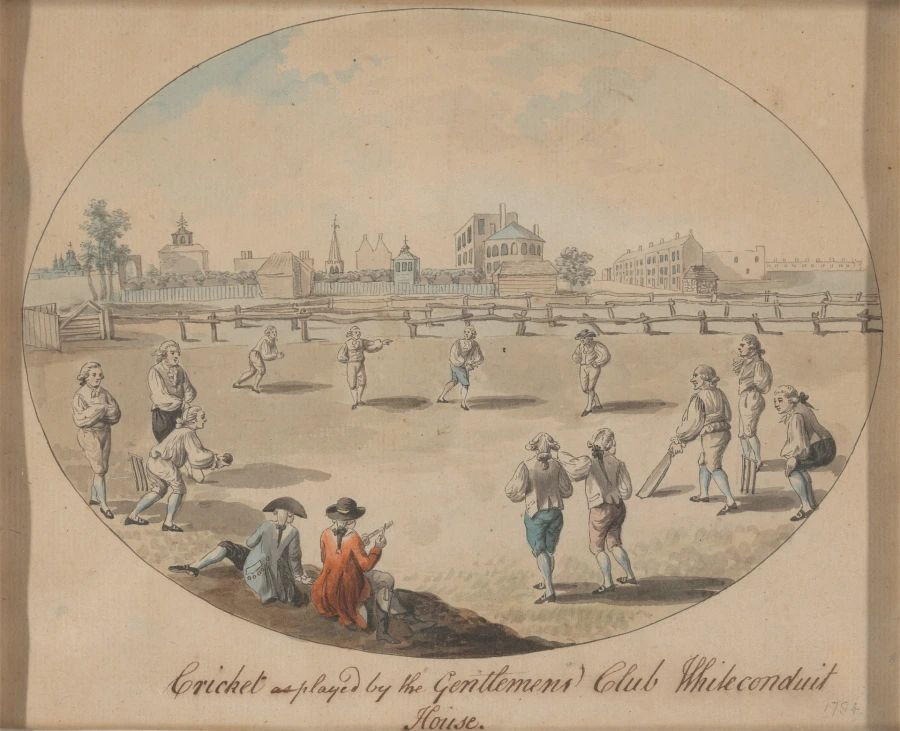
The starting point for Margaret Graham’s first solo flight, White Conduit House, was a popular resort on the edge of the metropolis, known for its pleasure gardens and tea shop. A late 19th century rebuild of White Conduit House still stands, just around the corner from the Barnsbury Jobcentre, where it is now home to a Georgian restaurant.


On the way from White Conduit Gardens, Margaret would have flown over Liverpool Road, passing between the modern day Angel Centre and Business Design Centre, over Islington Green and then past the tower of St Mary’s Church between Upper Street and Essex Road (then known as Lower Street).
She wrote that the tower of St Mary’s was “thronged with people” greeting her as she passed and even trying to shake her hand.

She also described seeing St Paul’s Cathedral and “every other church in the metropolis perfectly well”. As a regular member of the Islington Guided Walks team that leads tours of St Mary Islington, I like to imagine this when I am at the top of the tower admiring the view.

Her route then continued parallel to Essex Road, passing over the New River (likely at the modern day Astey’s Row Rock Garden), where “a great number of persons… huzzaed”.

Soon after that, she flew over open fields between Essex Road and the New River to the site of St Paul’s Church (built 1826-1828 and the first of four Islington churches designed by Charles Barry). Finally, she would have crossed over what is now Newington Green Road before landing in a nearby field.
Her landing was earlier than expected, a gust of wind having forced a temporary touch down among some beans in a garden before the balloon rose once more. She then passed through a tree and landed in a field, “when, to my delight, the first person that caught hold of the car was my husband”, who had been following her flight on horseback.


In Margaret Graham’s three decades as an aeronaut she endured crashes, falls, collisions with buildings and balloon blazes. The first manned balloon flight had taken place in France only in 1783 (the Montgolfier brothers) and the first in Britain was in 1784 in Edinburgh (James Tytler) soon followed by the first in London, at the Artillery Ground in Finsbury (Vincenzo Lunardi).
Those pioneering days of humanity taking to the skies attracted risk-takers. Safety was not the top priority and mishaps were common.
In the summer of 1836 Margaret was involved in a serious accident. While pregnant with her eighth child, she ascended with the Duke of Brunswick before a fashionable and aristocratic crowd from the Flora Gardens in Bayswater.
After descending from the cruising height of 4 miles to a field near Doddinghurst in Essex, some 25 miles from the start of the flight, the duke stepped out of the basket as soon as it reached the ground. This caused the balloon to rise rapidly, setting off a sequence of events that led to Margaret falling from the craft and being “precipitated to the earth”.
Margaret later wrote:
“...I must distinctly state that I fell more than three hundred yards or one thousand feet. Having commenced my fall in a perpendicular position, I perfectly well remember that the silk pelisse which I had on at the time became fully inflated with atmospheric air, and prevented the rapidity of descent.”

Even allowing for the parachute-like qualities of her attire, her claim that she survived a fall of 1,000 feet seems highly dubious. Indeed, she also wrote that, during the fall:
“I was so far conscious to feel a thorough conviction of my inevitable destruction, and to offer up prayer to the Almighty for the preservation of my husband and dear children.”
Margaret landed on her head, suffered neck and back injuries and was unconscious for two weeks. She made a full recovery, but at the high cost of enduring a miscarriage of her baby.
In 1838 one of Margaret’s flights led to a fatality. An ascent with a Captain Currie to celebrate Queen Victoria’s coronation ended in a crash landing on a house in Mayfair. The two aeronauts were unscathed, but a 26 year-old man called John Fley died after being struck by falling rubble.
In 1850 Margaret Graham achieved another first, becoming the first woman to ascend in a balloon at night in a flight from Vauxhall Gardens with her daughter Alice. Her balloon displayed the name MRS GRAHAM in huge letters and a firework display accompanied the ascent.

Shortly afterwards, on 7 August 1850, she survived a balloon fire during a descent near Edmonton (today part of north London). She received scorches to her face and clothes, but was undeterred and soon back in the air.
Margaret Graham (née Watson) was born in Walcot near Bath in 1804. She married chemist and balloonist George Graham at some point before they moved to London. The couple had at least 10 children, including three daughters reported to have flown with their parents, separately and together.

The couple put on frequent aeronautical shows for paying audiences and Margaret also often flew solo. They also earned money by charging to take other people on a flight.
Margaret Graham was a great self-publicist, developing a mutually fruitful relationship with the press and boosting her celebrity by writing accounts of her flights.
She was a trailblazer in advocating the right of women to fly on equal terms with men. In her press reports of her own exploits she attacked those who were more judgemental of her crashes and accidents than they were of male balloonists.
Mrs Graham’s aeronautical career was the defining feature of her life. It lasted from the early 1820s to the early 1850s, during which time she was a celebrity. She and her husband contributed significantly to the popularity of ballooning.

In the UK census of 1851 she described herself and two eldest daughters as ‘aeronauts’. It was very unusual for a woman not of the ‘labouring classes’ to list any form of occupation, much rarer still such a remarkable one.
In addition to being experienced operators, the Grahams also sought to advance the skills and practice of ballooning. They pioneered the use of coal gas, an industrial by-product available from the mains, which was cheaper than hydrogen.
Margaret wrote that she and her husband did not see “the science of aerostation” only as a form of entertainment. In order for it to “become a source of utility as well as pleasure”, Mr Graham developed devices to allow balloons “to go to what point he pleases, and also to remain up any length of time without loss of either gas or ballast.”
Margaret and George Graham flew a number of flights over the Crystal Palace in Hyde Park during the Great Exhibition of 1851. During one of these, the balloon fabric was punctured by a pole on top of a building.
Their grappling iron, dangling from the basket, narrowly missed damaging the Crystal Palace only because the Grahams rapidly ejected all the ballast. However, the iron did cause damage to nearby houses before catching onto the roof of a mansion, causing the two aeronauts to be thrown onto the roof.
George received injuries that ended his ballooning days, but Margaret continued a few years longer until 1853 or 1854. She had enjoyed a long career and much luck in surviving many accidents. However, legal and financial difficulties eventually caught up with her.
The picture below, first published in 1851, is a balloon view of London from Hampstead looking south. The previously unknown panoramic view of the capital gives an idea of why ballooning was such a passion for Margaret and other 19th century aeronauts.

Margaret died in her bed in 1864, at the age of 60 and in a state of impoverishment. She was buried in an unmarked grave in Abney Park Cemetery in Stoke Newington, a sad fate for such a pioneering and previously celebrated woman.
Although George was 20 years older, he outlived Margaret by three years.
After a fund-raising appeal in 2022, the Abney Park Trust erected a slate headstone as a memorial to her, surrounded by a low wicker fence (perhaps intended to suggest the baskets in which she once flew beneath her balloon).
Carved by local stonemason Charlotte Ruse, the monument bears an image of a balloon and the inscription:
MARGARET GRAHAM
1804 - 1864
CELEBRATED AERONAUT
- AND -
FIRST BRITISH WOMAN
TO FLY SOLO
IN 1826
BURIED NEARBY
WIFE OF AERONAUT AND CHEMIST
GEORGE GRAHAM 1784-1867
After 158 years, this groundbreaking aeronaut finally had a fitting memorial.

Please take a look at my YouTube video to see the route of Margaret Graham's first solo flight in Islington as the area looks today:
My thanks to Matt Brown of Londonist for first bringing Margaret Graham’s story to my attention.
Walks available for booking
For a schedule of forthcoming London On The Ground guided walks and tours, please click here.


Great story!!