
Quentin Blake Centre for Illustration: New River Head’s new gallery
The world’s largest illustration museum is housed in historic 18th/19th century waterworks near Sadler’s Wells Theatre.

I recently visited the new Quentin Blake Centre for Illustration, which officially opened on 5 June 2026. The largest dedicated space for illustration in the world and the UK’s only charity for illustration, it is located in the historic New River Company’s former waterworks in Clerkenwell.
Walks available for booking
For a schedule of forthcoming London On The Ground guided walks and tours, please click here.
What was originally called House of Illustration was founded by Sir Quentin Blake in 2002 and has previously occupied premises in Granary Square near King's Cross Station. The 93 year-old, who is best known as a children’s illustrator, has worked on more than 300 books.
After announcing the move to the historic New River Head location in July 2020, the former industrial site was restored and repurposed at a cost of £12.5 million. It was funded by the National Lottery Heritage Fund, the London Borough of Islington, a number of trusts and Quentin Blake.

The site’s three galleries include one dedicated to Blake’s work and two others where exhibitions will rotate (a £15 ticket gives admission to all three). A public library of books on illustration and a café are accessible without a ticket to the galleries.

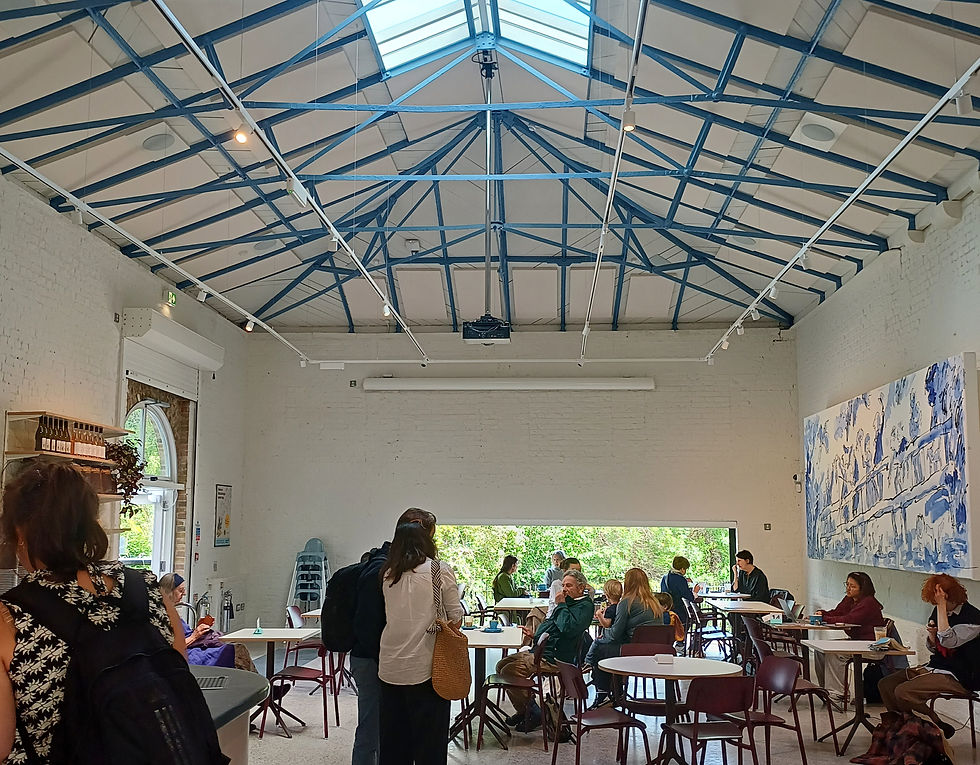
The site also includes a creative studio, project space, gardens and a shop in addition to the imaginatively restored 18th and 19th century pump houses of the New River Head.
The New River was constructed between 1609 and 1613 to bring fresh water from springs in Hertfordshire to the City of London. It flowed along a winding 38 mile course, 10 ft wide, 4 ft deep and with an incline of five inches per mile.
The water eventually reached the Round Pond at New River Head, which is now off Roseberry Avenue near Sadler’s Wells Theatre, but was then a rural location.

From there, it was channelled into the City through pipes made from hollowed-out tree trunks. The flow was controlled by stopcocks and cisterns in the Water House constructed by the Round Pond, although around 25% of the water leaked out of the pipes on the way to London.

The driving force behind the completion of the New River was Welshman Sir Hugh Myddelton, an MP and wealthy goldsmith whose statue is on Islington Green.
King James I rescued the project when it ran into financial trouble, providing fresh funds in return for a 50% stake. His son, Charles I, sold the Crown’s share of the New River Company in 1631 (although he would have benefited financially from future dividends by retaining the stake).
Over time, additional overflow ponds and cistern houses were developed around the Round Pond. The ponds became popular among anglers in the 18th century.
In 1708 the New River Company built a higher reservoir - known as the Upper Pond - at what is now Claremont Square, off Pentonville Road. This allowed greater pressure so that water could reach Soho and the West End. Water was pumped from the Round Pond to the Upper Pond, powered at first by a windmill, then by horses and from 1768 by a steam engine.

In 1904 the Company was absorbed into the Metropolitan Water Board, which built its new headquarters at New River Head nine years later.
In 1974 the MWB became part of Thames Water, which was privatised in 1989. The New River Head offices were converted into flats.
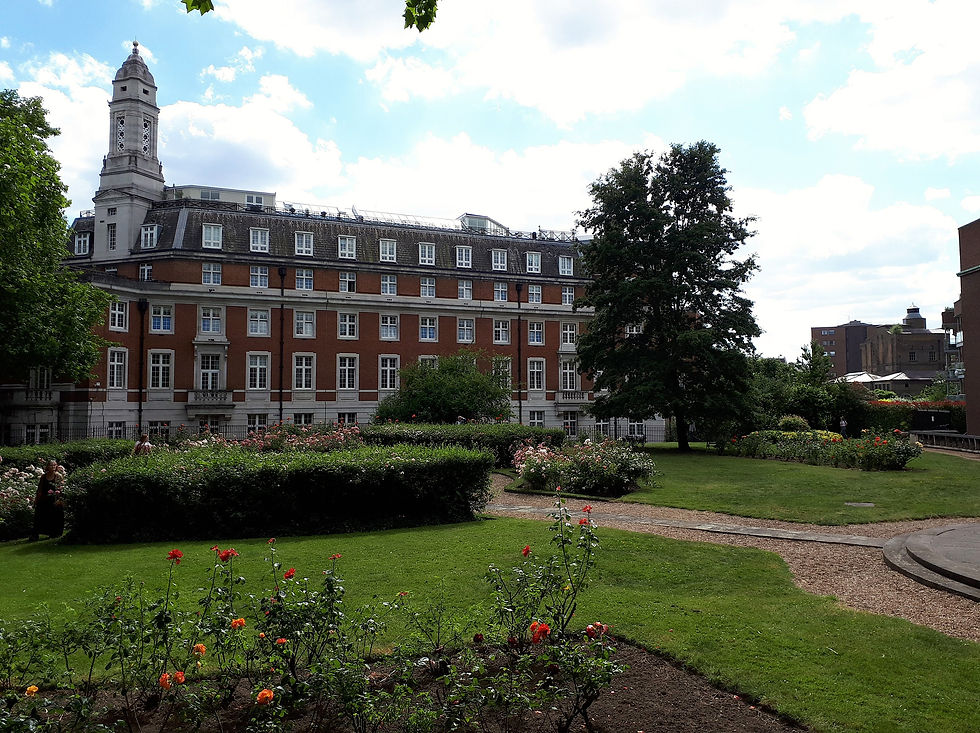
Given the poor reputation of Thames Water in recent years, it is just as well for the Crown that Charles I sold the Royal family’s stake nearly 400 years ago (although Thames Water probably doesn’t leak as much water as the original New River Company).
The New River still supplies something like 6% of London’s water. Since 1946 it has terminated in a reservoir off Green Lanes, between Finsbury Park and Stoke Newington, about three miles north of New River Head.

Before the renovation and conversion of the former water works buildings began, the House of Illustration briefly opened the site to visitors in September 2022. Comparison of my photos at that time with pictures I took in June 2026 demonstrate the success of the restoration project, led by Tim Ronalds Architects.
The windmill that once powered the pumps to take water from the Round Pond to the Upper Pond was lowered in size in the 18th century and reduced to its current size for use as a store in the mid 19th century. It now provides additional gallery space.
Above: The exterior of what is left of the windmill, 2022 and 2026
Above: inside the former windmill building, 2022 and 2026
The former engine house, originally built in 1768 for the steam engine that powered the pumps, was improved and extended later in the 18th century and in the 19th century. It now houses the three exhibition galleries, the library, shop and café.
Above: the former windmill and engine house, 2022 and 2026
Above: the former engine house, 2022 and 2026
Above: exhibition space, 2022 and 2026
Above: the outside of the former coal stores, now the café terrace, 2022 and 2026
Curiously, the current exhibition of Quentin Blake’s work, entitled Performance, has some (perhaps coincidental) links to the immediate neighbourhood of the House of Illustration.
The exhibition includes illustrations Blake created for a book called Angelo in c.1970. It was inspired by the traditional Italian commedia dell’ arte theatrical performance style, one of the principal characters of which is Harlequin, whose diamond-patterned clothes feature in Blake’s images.

A short walk away from the gallery, on Arlington Way, there is a pub called The Harlequin.

Commedia dell’ arte was a major influence on the British pantomime tradition, in which Sadler’s Wells Theatre played an important part in the 18th and 19th centuries. The Harlequin pub is next door to, and behind, Sadler’s Wells, which inspired its name.
Sadler’s Wells is now famous as a dance theatre, but it was once also an important venue for Shakespeare’s plays, particularly in the 19th century and (under the management of Lillian Baylis) in the 20th century. See this post for more on the history of Sadler's Wells.
The Shakespeare’s Head pub, also on Arlington Way, is a nod towards this aspect of the history of Sadler’s Wells.

Fittingly, Quentin Blake’s Performance exhibition also includes a significant Shakespearean element: a series of crow-like characters created for ‘The Macbeth’ collection of Scotch whiskies for distillers Livingstone in 2023.

In addition to Quentin Blake: Performance (continues to 1 April 2027), the other two current exhibitions are Queer as comics (to 4 October 2026) and MURUGIAH: Ever Feel Like… (to 31 August 2026). I can recommend all three.
Quentin Blake Centre for Illustration is open Wednesday to Sunday, 10am-5pm.
Above: inside the former windmill building, 2022 and 2026
Above: the former engine house, 2022 and 2026
Above: the former engine house and windmill, 2022 and 2026
Above: derelict pumping equipment, 2022, and a drawing by Sharpay Chenyué Yuán, made for an Engine House Graduate Residency in 2021

Model of the old windmill at the New River Head, by Philip Crewe, made during a residency at the Centre from the finial that fell off the roof of the former windmill in a storm (photographed by me inside the building in 2022)
Walks available for booking
For a schedule of forthcoming London On The Ground guided walks and tours, please click here.


Comments