
Islington’s cricket heritage

Islington’s cricketing legacy includes Lord's, the MCC, Middlesex County Cricket Club and women’s county cricket.
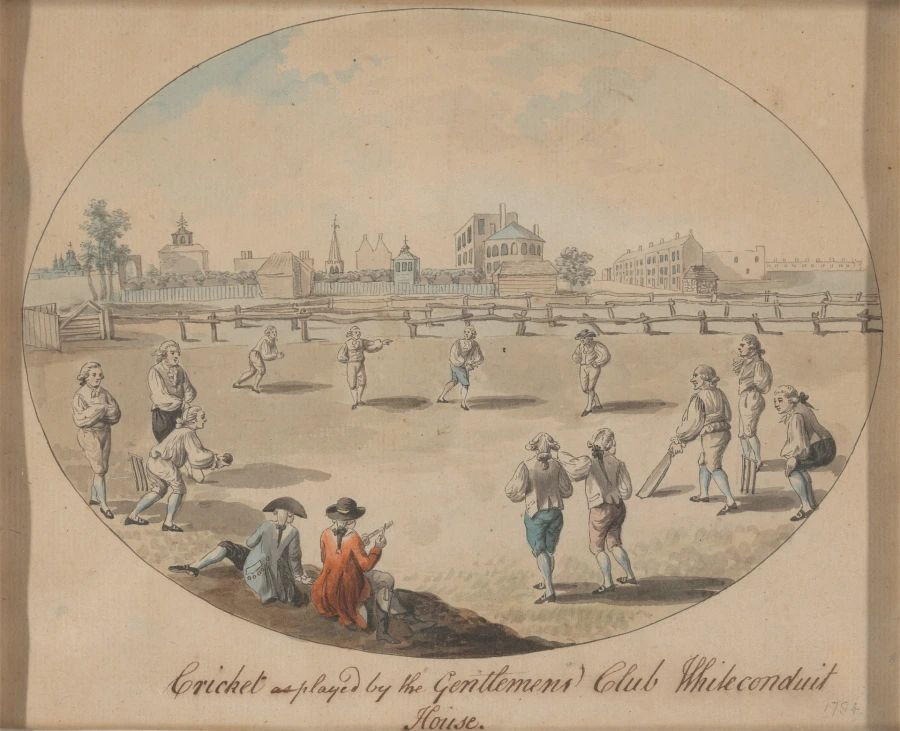
Today, Islington is well known as the home of Arsenal Football Club, while the sport of cricket hardly features. The borough is home to only one public cricket pitch (Wray Crescent off Hornsey Road), but Islington played an important role in the history of cricket in the 18th and 19th centuries, making a significant impact on the game to this day.
Walks available for booking
For a schedule of forthcoming London On The Ground guided walks and tours, please click here.
The earliest known cricket ground in Islington was White Conduit Fields, in Barnsbury, when this area was still open countryside. It hosted a notable match on 1 September 1718 between London Gamesters and Rochester Punch Club.
At the time it was common for matches to be played for a cash prize, with both teams (or other underwriters) putting up stake money. The London team was winning when three Rochester players left, forcing the match to be stopped, in an attempt to keep their stake money.
However, a court ordered the completion of the match, which took place 10 months later in Jul 1719, ending in a 21 run victory for London. This is the earliest record of a clear result of a cricket match.

As we shall soon see, White Conduit Fields remained significant in the history of cricket.
Other early references to cricket in Islington, in the late 1720s and early 1730s, concern games scheduled in the fields behind the Woolpack Inn. This stood on St John Street, close to the junction with Goswell Road (a short distance south of today’s Angel tube station).
An advertisement in Read's Weekly Journal or the British Gazetteer announced a game on 5 August 1728 or 1729 (depending on which source you read) between the Gentlemen of Middlesex and the Gentlemen of London, to be played at the "Woolpack Back Gate near Sadler's Wells" for £50 a side.
This was the first known reference to a team called Middlesex and the first known use of the term Gentlemen to refer to amateur players of cricket (although they played for a competitive stake).
A similar advertisement appeared in the London Daily Post and General Advertiser promoting a match scheduled for 7 August 1732 between London and Middlesex at the same location.

In neither of these two cases is there any record of the advertised match actually taking place, or of the result. Moreover, the Woolpack ground would have been little more than an open field, with no infrastructure for spectators.
Nevertheless, the advertisements demonstrate that Islington was an early host for cricket as it gained popularity and became more organised in the 18th century.
The Artillery Ground in Finsbury, which belongs to the Honourable Artillery Company (HAC), is another early cricket ground in today’s London Borough of Islington.

The first mention of cricket there is in 1725, when the HAC was unhappy about damage to the grass caused by exercising horses and by “Crickett Players”.
Nevertheless, a match between Middlesex and Surrey took place at the Artillery Ground in 1730. By the 1740s, there are records of cricketer and groundskeeper George Smith charging tuppence admission to watch cricket there.
The ground was London’s leading cricket venue for many years. It hosted its last historically important match in 1778, but the HAC and other teams still play cricket on what is possibly London’s oldest continuously used sports ground.
(For more about the HAC and its connections with the City of London, see this post from 2022.)

The Artillery Ground was the main venue for matches played by the London Cricket Club, one of the most important cricket teams of the 18th century. It was formed in 1722 by members of the Star and Garter, an elite gentleman’s club in Pall Mall with which it continued to be closely connected.
The London Cricket Club disbanded during the Seven Years War (1756-1763), when many of its members left the London area for Hambledon Club in Hampshire.
In the 1750s and 1770s, the Star and Garter hosted meetings that codified the laws of cricket.
Back in White Conduit Fields, a group of aristocratic former members of the London Cricket Club formed the White Conduit Club in 1785. Its 144 founder members agreed to rules covering a range of topics such as social arrangements, player eligibility and financial arrangements.
Among other things, the rules stipulated “None but gentlemen ever to play”. They also required members to attend dinners at the Star and Garter, not to dispute umpires’ decisions (or else be fined), not to be late for matches, not to bring horses or carriages onto the cricket ground and to pay for any damage done in “the tent” (presumably a forerunner of the cricket pavilion).

It seems that the rules were largely aimed at maintaining the club’s exclusivity. However, a public footpath led across the ground and members of the public would watch matches and loudly share their opinions of the players. The gentlemen of the White Conduit Club did not consider the fields of Barnsbury sufficiently private.
They instructed Thomas Lord, their ground attendant who also bowled to members wanting batting practice, to find a new and more secluded venue. In 1787, they moved west to Dorset Fields, owned by the Portman Estate, between the villages of Marylebone and Paddington, where Dorset Square is today.
This was the first Lord’s Cricket Ground.
Lord, a wine merchant with contacts in real estate, leased the site from the Portman Estate and rented it to the newly formed Marylebone Cricket Club (MCC). The MCC’s first match was against the White Conduit Club, although the older club had ceased to play by the end of 1787.
Thomas Lord terminated his lease on his first ground in 1810, since he was unhappy with a rent increase. He took his turf to his second ground, in St John's Wood, in 1811.
The construction of the Regent’s Canal then forced a move in 1814 to his third ground. Also in St John’s Wood, this remains the location of Lord’s Cricket Ground, the most famous cricketing venue in the world and regarded as the home of cricket.
The MCC updated the laws of cricket in 1788 and has been the custodian of the laws of the game ever since.
This was not yet the end of White Conduit Fields' cricket story. The Islington Albion Cricket Club played there from 1805 until 1834.
The club was named after the Albion tea house, which was built in c.1800 and overlooked the cricket field. Its name referred to its owner, Thomas Albion Oldfield, who also ran a dairy and gardens. The tea house is now the Albion pub, on Thornhill Road.

In 1834 the Albion Cricket Club moved to a field near Copenhagen House, around a mile to the north, and then to Holloway and Alexandra Park before ceasing in the 1890s.
Islington also played a part in the history of Middlesex County Cricket Club.
Although there are references to a team representing Middlesex as early as the late 1720s, the present Middlesex County Cricket Club was founded in December 1863 (at the City of London Tavern, see City pubs past: half a dozen lost City of London inns and taverns). It played its first match in Islington, at the Cattle Market Ground, against Sussex on 6 and 7 June 1864 (Middlesex won by 52 runs).
The Cattle Market Ground was next to the Metropolitan Cattle Market off Caledonian Road. The first match at this venue, between Middlesex Clubs and a United England Eleven, took place in 1863. The last recorded match here, the Gentlemen of Middlesex versus the Australian Aboriginals, was in September 1868, after which the land was sold for development.
Middlesex County Cricket Club used a number of grounds in subsequent years before moving to Lord’s, which has been its permanent home ground since 1877. It is a tenant of the MCC at Lord’s, reuniting two strands of Islington’s cricket history (albeit in the City of Westminster)
Islington was also host to a significant even in the history of women’s cricket.
The first recorded women’s match involving two county sides, Surrey and Hampshire, took place near Ball’s Pond in October 1811. According to an article written in 1961 in The Cricketer, the location was a field owned by a Mr Story, in what was still a rural area between Ball’s Pond Road and Newington Green (incidentally, very close to part of the recent Arsenal parade route).
Eschewing the cricketing tradition of wearing whites, the Surrey team wore orange and blue and Hampshire wore true blue. A contemporary writer, Pierce Egan, said the play was “ very excellent” and was watched by “an unusual assembly of elegant persons”. The players’ ages ranged from 14 to 60, the eldest of which was Ann Baker, who was said to have been the best runner and bowler on the Surrey team.
Hampshire won by 14 runs after a match that started on Wednesday 2 October, continued on the Thursday and concluded on Monday 7 October. The match was underwritten for 500 guineas a side by two noblemen of the respective counties, who also provided “handsome entertainment” at the Angel Inn at Islington after the match.
An illustration of the match, Rural Sports or a Cricket Match Extraordinary, by artist and caricaturist Thomas Rowlandson, was published on 10 October 1811.

It shows the teams’ colours, the spectators (including two playing catch, one tripping over a dog) and two scorers recording the runs by making notches on sticks. The banner on the tent reads ‘Jolly Cricketers’. In the background, on the left, a smoking brick kiln is a sign of the imminent urbanisation that would soon swallow these fields forever.
Islington is rightly known for its footballing heritage. My last blog post highlighted the history of the Islington Streets that hosted Arsenal Football Club’s recent victory parade.
With the cricket season in full swing and a test match currently underway at Lord’s, Islington’s cricketing legacy should also be remembered.
Walks available for booking
For a schedule of forthcoming London On The Ground guided walks and tours, please click here.

Comments