
Seely and Paget: the centenary of the notable architectural Partnership
The Partners’ work included Eltham Palace and post-war restoration of London churches, St Paul’s and Westminster Abbey.

John Seely and Paul Paget, Partners in life as well as in business, produced architecture that combined old and new with sensitivity and flair in the middle decades of the 20th century.
They met in around 1920 at Cambridge University, where Seely read Architecture and Paget read English (but he never graduated), and became great friends. On 7 March 1926, over lunch at the Mitre in Hampton Court, John Seely asked Paul Paget to go into Partnership with him in an architectural practice.
Walks available for booking
For a schedule of forthcoming London On The Ground guided walks and tours, please click here.
When Paget complained that he knew nothing of architecture, Seely said that he would look after the designs and Paget would look after the clients. The Partnership was formally registered later that year.
It worked very well. The designs were Seely’s, but he always agreed them with Paget. Paul Paget later said “it was a marriage of two minds… we became virtually one person.” Each referred to the other as ‘The Partner’.
It did their architectural practice no harm that they were both very well connected with the British Establishment.
John Seely (1899-1963) was the eldest surviving son of General Jack Seely, a senior soldier and politician, who had a large estate on the Isle of Wight, and was the godson of Winston Churchill.
The General gave the Partners their first project, namely to restore the family home, Mottistone Manor, and asked the noted architect Sir Edwin Lutyens to check the plans.
Seely senior was created Baron Mottistone in 1933, a title that Seely junior inherited when his father died in 1947. Having ‘Baron Mottistone’ on his business card helped to open doors.

Paul Paget (1901-1985) was the son of Henry Paget, Bishop of Stepney and then of Chester. His Church of England connections helped Seely and Paget to win commissions for church reconstruction projects after World War II.

Reconstruction and restoration formed a large part of their career, but they also built a number of new churches and other buildings around the country. In addition to many projects in London, they completed work at St George’s Chapel Windsor, Eton College, Oxford, Lee-on-the-Solent, Barrow-in-Furness, Durham, Stevenage, Cottesbrooke, Leatherhead and elsewhere.
This post cannot possibly provide a comprehensive view of all of Seely and Paget’s work. Rather, it is my personal choice of a dozen London buildings and sites associated with them.
1. Cloth Fair
Seely and Paget lived at 41-42 Cloth Fair, the oldest house in the City of London, which overlooks the Priory Church of St Bartholomew the Great and which was completed in 1614. The Partners bought it in 1930 and carried out a “sensitive and archaeologically accurate” restoration, according to Historic England’s official listing of the building.

From here they ran their professional, personal and social lives. Their society friends, including the Queen Mother, visited them here. A number of these friends, including Poet Laureate Sir John Betjeman, Stephen and Virginia Courtauld (see below), architect Sir Basil Spence and Hollywood director Arthur Hornblow, etched their names onto the glass panes of a first floor window.
They also owned 43 Cloth Fair, just across a narrow alleyway from their home, the upper flat of which they rented to their friend John Betjeman.

They commissioned artist and stained glass maker Brian Thomas, who worked with the Partners on many professional projects, to paint a scene called 'A Sailor's Homecoming' on a window at number 43 that had looked directly into their kitchen.
2. Eltham Palace
Eltham Palace in south London is probably Seely and Paget’s most spectacular work, carried out in 1933-35 for the Courtaulds. It combines a restored medieval great hall (that was once part of a palace where Henry VIII spent his childhood, but which had fallen into disrepair and had been used as a barn) with a new residential mansion with a jazz age interior and a Wren-inspired renaissance-style exterior.

See my post Eltham Palace: Medieval meets Art Deco for more on this unique architectural concoction.
3. All Hallows-by-the-Tower
A City Church overlooking the Tower of London, All Hallows-by-the-Tower has Saxon origins. It has structures from the 15th and 17th centuries, the only stone Saxon arch anywhere in London and a stunning carved lime wood font cover by Grinling Gibbons, Wren’s master carver. The 14th century crypt contains a fascinating museum containing fragments of London history ranging from a Roman tessellated pavement to a monument to William Penn, founder of Pennsylvania.
Damaged in the Blitz, the church was restored by Seely and Paget in 1948-59.

4. St Mary Islington
Islington’s oldest church, St Mary’s was the first London church to be hit in the London Blitz. The bomb, which landed near the altar on 7 September 1940, destroyed all of the church apart from its 18th century tower and spire. The main body of the church was rebuilt in 1956 to Seely and Paget’s simple and light-filled design, which fulfilled the theological wishes of the vicar at the time and met the budgetary constraints of post-war austerity. It includes painted murals by Brian Thomas.

Islington Guided Walks conducts monthly tours of St Mary Islington, which include a climb up the 120 steps of the tower to enjoy panoramic views across London (you might even get me as one of the guides!).
5. St John’s Priory Church
The Priory Church of St John, in Clerkenwell, has origins dating back to 1144, when it was built by the Order of St John of Jerusalem, also known as the Knights Hospitaller. Rebuilt by the Order of St John, plundered after the Dissolution of the Monasteries in the 1530s, it was rebuilt in the 18th century in a Georgian style as a second parish church for Clerkenwell.

Largely destroyed in World War II, today's red brick exterior by Seely and Paget is a nod to the Georgian style, while the interior retains some Gothic features but (as with St Mary Islington) on a tight post-war budget.

Please click here to read more about St John's Priory and the local Clerkenwell area.
6. Charterhouse
The Charterhouse was originally a monastery, the last to be established in the London area and the first to be closed by Henry VIII. It was converted into a Tudor mansion for the aristocracy after the Dissolution, before a wealthy commoner named Thomas Sutton established a school, chapel and almshouse here in 1611. The school moved to Godalming in Surrey in 1872, but the chapel and almshouse remain.
The Charterhouse suffered extensive bomb damage in World War II and was restored by Seely and Paget in the 1950s. Their work removed work carried out in the 19th century and returned the buildings nearer to their original condition, according to Historic England’s official listing.

7. Lambeth Palace
The London home of the Archbishops of Canterbury since around 1200, Lambeth Palace is on the River Thames, on the opposite bank to the Houses of Parliament. Its main buildings date from the 13th to the 17th centuries, with significant reworking in the 19th century. Damaged in the Blitz in 1941, Lambeth Palace was restored by Seely and Paget in 1954-55.

8. Tait Chapel, Fulham Palace
The chapel was originally built in 1867 under the direction of Bishop Tait at Fulham Palace, the historic home of the Bishops of London. It was designed by architect William Butterfield in the High Victorian Gothic style. Seely and Paget oversaw restoration to the Tait Chapel in 1953, after it had suffered bomb damage in World War II. The work included new murals by Brian Thomas.

9. St Andrew Holborn
A church with 10th century origins, St Andrew Holborn was not damaged by the Great Fire of London of 1666. Nevertheless, it was rebuilt by Sir Christopher Wren (well, it was dilapidated and Wren was already rebuilding 50 other churches and St Paul’s Cathedral). It was left in ruins after being struck by a fire bomb in the Blitz in April 1941. It was reconsecrated in 1961 after Seely and Paget completed its restoration.

10. City Temple
Seely and Paget carried out post-war restoration work on this Congregational place of worship next door to St Andrew Holborn, in 1954-58. This involved building a new concrete structure with stone panels between the original Bath stone end bays and the tower, whose cupola was restored.
11. St Paul’s Cathedral
John Seely was appointed Survey of the Fabric of St Paul’s – the cathedral’s architect, a position first occupied by Sir Christopher Wren – in 1956. The Partnership had already done significant work on churches across the country (and the Dean of St Paul’s, Walter Matthews, knew Paget’s father).
Two significant designs created by Seely for St Paul’s were the Chapel for the Order of the British Empire (OBE) and the pulpit.
The OBE Chapel (also known as St Faith’s Chapel, after a parish church that was originally attached to Old St Paul’s before the Great Fire of 1666) was completed in the crypt in 1960. It includes glasswork by the Partners’ friend and frequent collaborator, Brian Thomas.
Seely created the design for the wooden pulpit, which was approved by the Cathedral Chapter in 1962. Sadly, however, the architect did not live to see his design fulfilled. He died on 18 January 1963 just as the work was beginning.
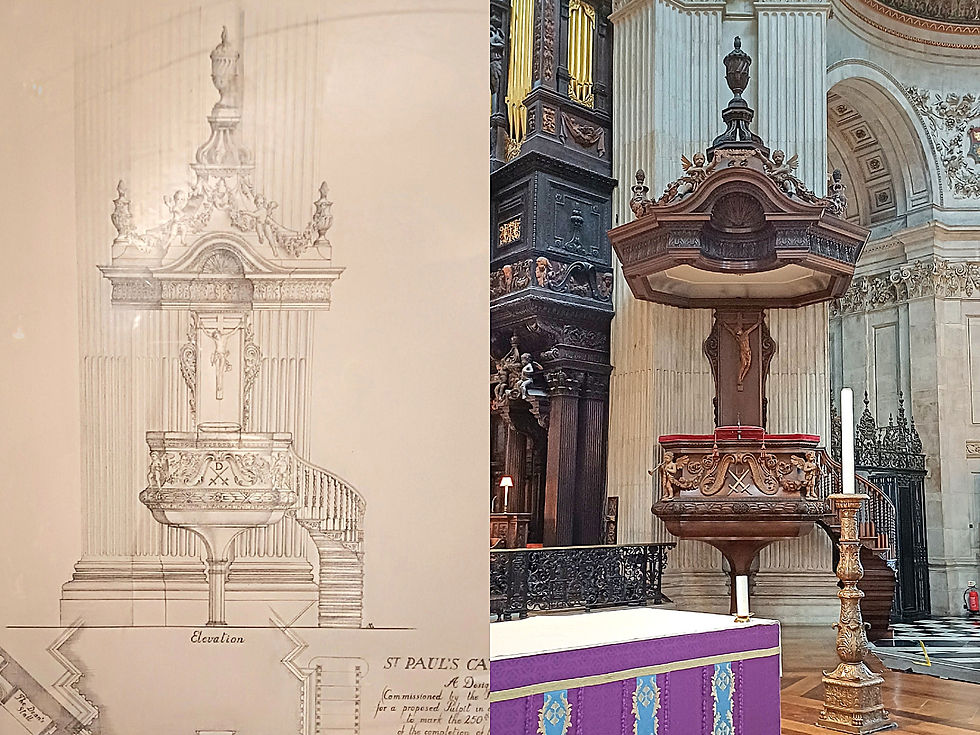
After John Seely’s death, Paul Paget continued to run the architectural practice until the late 1960s/early 1970s. Paget also took over as Surveyor of the Fabric of St Paul’s Cathedral, in spite of feeling somewhat uncomfortable about his lack of architectural training.
In this post, Paget supervised the completion of the pulpit, the construction of St Paul’s Choir School, the fibreglass reconstruction of the tower of St Augustine’s (a Wren church immediately to the south east of the cathedral that was badly damaged in the Blitz). He also oversaw the cleaning of the exterior and the reinstatement of timber and leadwork to the roof and dome.

12. Westminster Abbey
Seely and Paget re-built a number of Blitz-damaged houses in Little Cloister, a quiet and tucked away part of Westminster Abbey to the south of the Chapter House, and the Deanery.

After John Seely's death, Paul Paget and Alan Don, Dean of Westminster, erected a memorial to him in a niche on the wall of clergy houses overlooking St Catherine’s chapel garden, immediately to the east of Little Cloister in 1966. It is a fibreglass statue of St Catherine by Edwin Russell.
The Latin inscription on the memorial reads ‘Hoc signum amoris doloris’ (‘This is a sign of love and sadness’ and includes the initials P.E.P. (Paul Edward Paget) and A.C.D. (Alan Campbell Don).

After suffering the loss of his life partner, Paul Paget found a happy ending. He married writer Verily Anderson in August 1971 in St Bartholomew the Great, directly opposite the house where he had lived with John Seely on Cloth Fair. John Betjeman was best man, while actress and writer Joyce Grenfell was bride’s attendant.

The couple retired, with her children, to Norfolk (where they lived in a house designed by Seely and Paget for Paget’s uncle). After he died in August 1985, a thanksgiving service was held for Paul Paget in St Bartholomew the Great (please click here for more on this 900 year old church).
Seely and Paget have sometimes been criticised for not having their own style, but this is really because they worked to give the client what the client wanted and not what they wanted to push. It also reflects the importance of restoration in their body of work, which they largely achieved with sensitivity to the various original period styles.
What is beyond doubt is that they made a very significant contribution to architecture in the 20th century, both in the restoration of important historic buildings and in creating imaginative new ones.
Happy 100th anniversary to The Partners!

Walks available for booking
For a schedule of forthcoming London On The Ground guided walks and tours, please click here.


Comments