
Hubert Pragnell’s bombed City of London after World War II
Unpublished drawings of St Paul’s and Blitz-damaged Wren churches in the 1950s and 1960s.

Hubert Pragnell is an artist, historian, expert on architecture and author.
In the 1950s and 1960s he captured St Paul’s, Wren churches and other landmarks during the long years after World War II when the bomb-damaged City of London was awaiting reconstruction.
I am very grateful to Hubert for allowing me to present a selection of the stunning images he created in the City at that time. These pictures, mostly drawings in pen and ink, have not previously been published.
I would also like to thank Annemarie Fearnley for help with photographing Hubert's work.
Walks available for booking
For a schedule of forthcoming London On The Ground guided walks and tours, please click here.
Hubert studied fine art at Goldsmiths College London and the Ruskin School of Art in Oxford. He holds an MA from the University of Kent and a Ph.D. from the University of York.
Since 2003 he has been a tutor in History of Art and Architecture at Oxford University's Department for Continuing Education.

Previously, Hubert taught art and history of art at schools including Stonyhurst College in Lancashire and (for 29 years) the King's School, Canterbury. He has long been resident in Canterbury, but he grew up in south London.
He traces his interest in the history of architecture to his schooldays.
“At secondary school I was given a book, British Architects and Craftsmen by Sacheverell Sitwell, as a prize for general achievement," he told me. "This switched me on to the history of architecture and drawing or recording buildings.”
As early artistic influences, Hubert cites “the art of Turner and Constable and the wartime topographical drawings of London by Muirhead Bone, Hanslip Fletcher and Dennis Flanders.”
Turner and Constable need no introduction, but readers may be less familiar with the work of the latter three.
Muirhead Bone, a war artist during both world wars, was known for his industrial and architectural subject matter. Hanslip Fletcher was an illustrator with a particular focus on London’s architecture. Dennis Flanders, a specialist in English landscapes and buildings, was noted for his detailed drawings of bomb-damaged scenes created during World War II.
In the years after the war, the City of London’s still damaged churches provided Hubert with ideal subject matter for his detail-conscious, artistic eye.
“I was born in London during the war and so grew up used to seeing bombed buildings, especially those in the centre of London. The rebuilding of the City of London really got underway in the late 1950s, by which time I began ink drawings of views in the City and along the Thames at Greenwich.”
“I was particularly interested in the Wren churches and the dome of St Paul's, towering over the wasteland between Upper Thames Street, Cannon Street and the Barbican.”
Hubert’s favoured approach at this time was line drawings in ink, to which he sometimes added washes in sepia or thin watercolour. He also occasionally used charcoal, or painted full watercolours.
He was drawn to the transitional state of many of the buildings at that time.
“Perhaps not to everyone's cup of tea, I was fascinated by buildings in scaffolding - of course a sign of restoration. I was also conscious that, with restoration and rebuilding, certain viewpoints would disappear forever, so I wanted to record them.”
A growing interest in the history of London prompted him to join the London Topographical Society. He contributed to several of their publications, for example the London Panoramic views of Robert Barker and Thomas Girtin in 1969 and The Stone Gallery Panorama: Lawrence Wright's view of the City of London from St Paul's Cathedral. c.1948-56 in 2018.
Hubert has channelled his wide-ranging knowledge of architecture and his skills as a draughtsman to write and illustrate a number of publications, including The Styles of English Architecture (1984) and Britain: a Guide to Architectural Styles (1995).
His particular interest in Britain’s industrial and transport infrastructure was developed in his PhD thesis on early railway tunnels and informed his 2001 book Industrial Britain: An Architectural History and his 2024 book The Early History of Railway Tunnels.
He has also written and illustrated Oxford in Watercolour (2011) and An Artistic Tour of York (2014).
Hubert continues to paint landscapes in watercolour and pastel and to maintain active sketchbooks on places he visits both at home and abroad.
Hubert Pragnell’s bombed City of London
The first drawing below, from 1959, is of St Paul's Cathedral and St Nicholas Cole Abbey (with a bus running along Queen Victoria Street in front of it).
The second, made in 1964 from a vantage point slightly to the southwest of the first, adds the tower of St Mary Somerset to the two landmarks depicted in the first drawing. Note that the spire of St Nicholas Cole Abbey had been restored by 1964.


The next three pictures are of Christ Church Greyfriars on Newgate Street. The first two, from 1959, show the church tower under scaffolding while the spire had been taken down for repairs. The third shows that the spire had been restored by 1965, but the east and south walls had yet to be removed to let in sunlight for the plants later planted in the ruined church.


The next three photos are all of Queenhithe, an ancient harbour in the City of London formed from an inlet of the Thames (see also my post Queenhithe: one of London's oldest landmarks). The first shows Smiths Wharf, which was on the north side of Queenhithe, while the other two images are looking west across the harbour (the second shows the chimney of Bankside Power Station, now the Tate Modern, across the Thames).
Click on any image to enlarge
Smiths Wharf, Queenhithe , 1963. © Hubert Pragnell, reproduced with permission Towards Bankside Power Station from Queenhithe , 1959. © Hubert Pragnell Looking west across Queenhithe , 1963. © Hubert Pragnell
The next two pictures are from 1970 and 1971, showing that some bomb sites remained undeveloped for a very long time after the war.

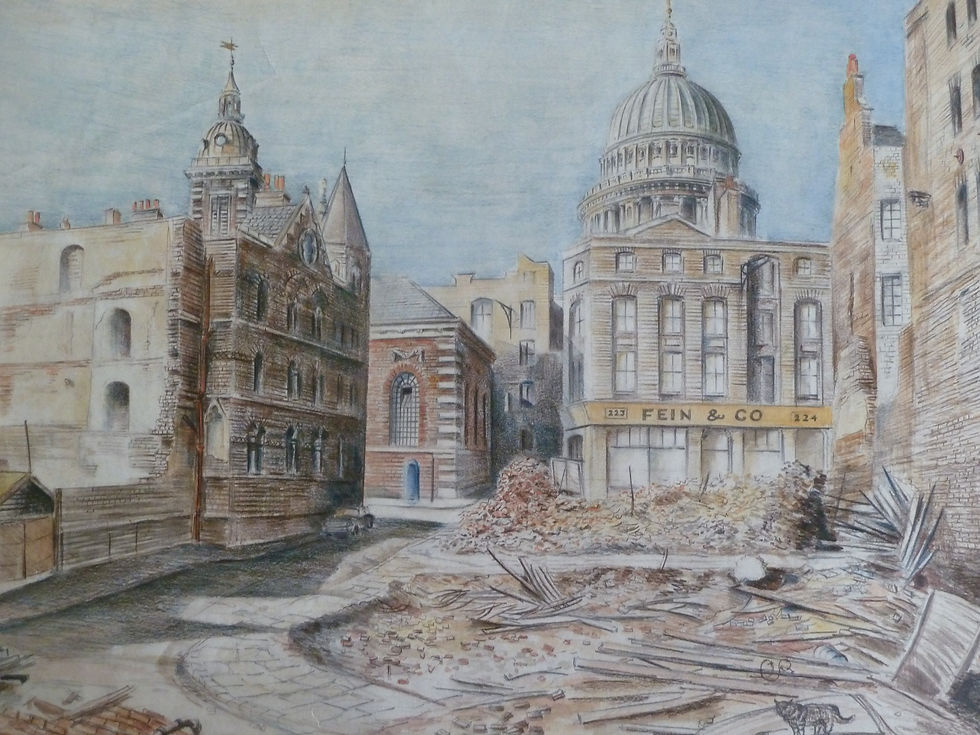
The 1959 ink and wash image depicting the spire of St Bride's church on Fleet Street, below, shows the railway viaduct that ran across the bottom of Ludgate Hill until the 1990s. Hubert must have drawn this from where the City Thameslink station now stands, on the south side of Ludgate Hill.

Next are two drawings of St Giles Cripplegate from the early 1960s, long before the Barbican Estate was built around the medieval church.


Below is Hubert's 1962 drawing of St Mary Aldermanbury, still some years before it was dismantled and rebuilt in the United States (see also my post St Mary Aldermanbury: Wren church, Churchill (and me)).

The next three images are of St Mary-le-Bow, Cheapside, while under repair in 1961. The first two are from Bow Churchyard, while the third shows the spire rising above the shops on Bow Lane from a vantage point on the corner with Watling Street.


The next five pictures all depict St Paul's Cathedral from different angles, between 1959 and 1965. The first is from Amen Court, off Ave Maria Lane, while the second is from Bankside on the south of the Thames.


The image below shows St Paul's at night, from what is now Paternoster Square, while the one after it is from a position a short distance further east.


The final image of St Paul's was drawn while the lead on the dome was being repaired and replaced in 1965.

In recent years, Annemarie and I have had the good fortune to share our mutual enthusiasm for London’s architecture and history with Hubert on a series of strolls in the City, Southwark, Clerkenwell and Islington.
Hubert once wrote that, for him, “architecture is more important than a hot meal”. On a number of occasions it has been my pleasure and privilege to enjoy both architecture and a hot meal with Hubert.


Walks available for booking
For a schedule of forthcoming London On The Ground guided walks and tours, please click here.


How wonderful to have Hubert’s drawings altogether in this post!