
The secret gardens of Westminster Abbey

The gardens of one of London’s most famous historic buildings offer unexpected delights (but go on a sunny day).

Westminster Abbey’s appeal extends beyond the main attraction of the ancient church itself. There are also some wonderfully secluded and historic gardens, which combine beautiful plants and trees with unfamiliar views of the Abbey and the nearby Palace of Westminster.
Westminster Abbey – strictly the Collegiate Church of St Peter at Westminster – was originally the location of a Benedictine monastery founded in the 10th century.
Walks available for booking
For a schedule of forthcoming London On The Ground guided walks and tours, please click here.
Today’s church was commissioned by King Edward the Confessor and consecrated in 1065, although it was subsequently rebuilt in the 13th to the 15th centuries. The two western towers were added by architects Nicholas Hawksmoor and John James in the 1740s.
The site of every coronation since 1066, a place for the funerals and weddings of royalty and the burial of statesmen, artists, writers, scientists and other members of the great and the good, Westminster Abbey’s history, architecture and associations are fascinating and almost endless.
In this post, however, I ignore all that and focus instead on the lesser known, but very lovely, gardens of the Abbey. I visited on a beautifully sunny day in early March that made me yearn for Spring and inspired me to write about these gardens in my blog.
The Cloister garth
Arguably not really a garden, the garth is the lawn within the Abbey’s main Cloisters. In medieval times the Cloisters were a busy location where monks spent a good deal of the day. The four sides to the Cloisters were built mainly in the 13th to the 15th centuries and are each approximately 100 feet (30 metres) long.
The garth is not open to the public, but can easily be seen from the Cloisters. In the centre of the lawn is a fountain commemorating the 18th century landscape gardener Lancelot ‘Capability’ Brown. Completed in 2018, the fountain was erected to mark the 300th anniversary of Brown’s birth (although he was born in 1716, so it was a bit late!).

Little Cloister
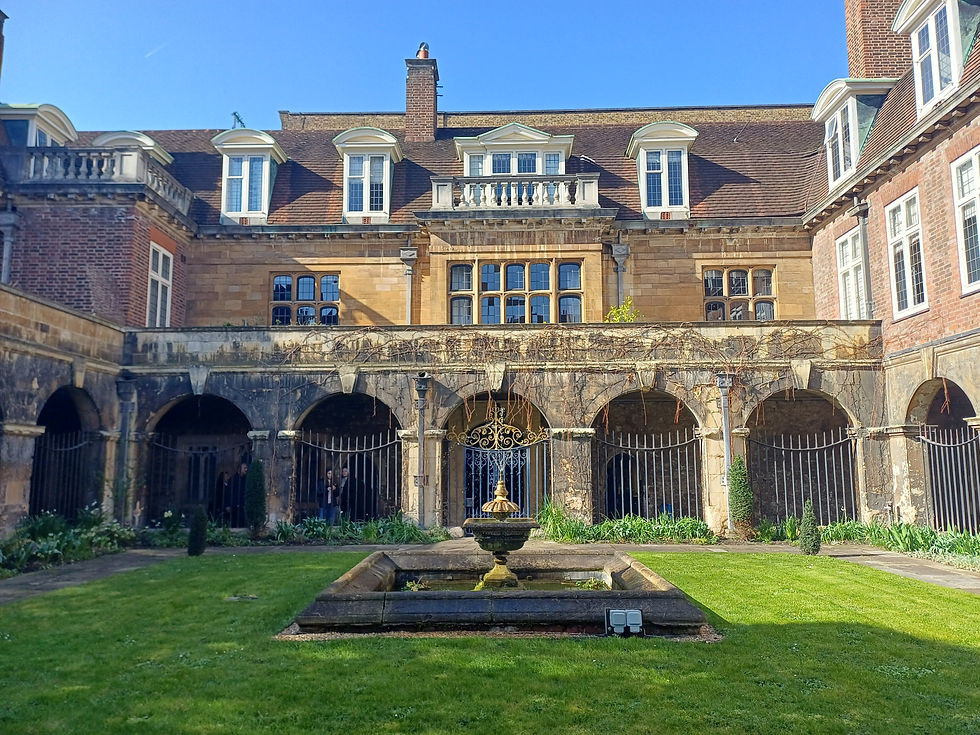
A quiet space in the Abbey complex, the Little Cloister can be reached off the south east corner of the main cloisters. From the late 14th century until the Dissolution of the monastery by Henry VIII in 1540 it was a place for convalescing monks to recover from illness. Their recovery was soothed by the sight and scent of the garden’s flowers and aromatic plants and the trickle of a fountain in the centre.
Today’s Little Cloister Garden, which dates from the 18th century, remains a tranquil and soothing space, surrounded by residential accommodation for members of the clergy. While the public cannot walk into the garden, it is small and can be enjoyed from the covered walkways of the Little Cloister.
St Catherine’s garden
Immediately to the east of the Little Cloister is a small garden on the site of St Catherine’s chapel, which was built for the Abbey’s infirmary around 1154-1161. The chapel was also used for the consecration of many bishops in the 12th and 13th centuries. Moreover, in 1253, this was where Henry III swore to uphold Magna Carta, the great charter originally agreed by his father King John.
After the Dissolution in the 16th century, the chapel fell into ruin and was eventually demolished.
St Catherine’s chapel garden as we see it today was laid out after this area of the Abbey was damaged in World War II. It is private, but the public can look across the garden from the Little Cloister through what was once the chapel’s west doorway (added in 1371).

In a niche in the wall of the north side of the garden, a statue of St Catherine forms a monument to John Seely, of the architectural firm Seely and Paget, who carried out post-war reconstruction of clergy houses here. For more on Seely and Paget, who formed their partnership 100 years ago in 1926, please read my post Seely and Paget: the centenary of the notable architectural Partnership.
College Garden
At just over one acre, College Garden is the largest of the Westminster Abbey gardens. It has been cultivated for more than nine centuries and has been open to the public since 1966.

When the Abbey was a monastic community, this area just south of the Little Cloister was used to grow fruit and vegetables and to grow herbs for medicinal purposes. It was tended by a Head Gardener, with two monks as under-gardeners, under the supervision of the Abbey’s Infirmarer (the head of the infirmary).
There were also fish ponds, beehives, a dovecote (a house for pigeons or doves) and archery butts. The latter was used for exercise by the (presumably) otherwise peace-loving monks.
After the Dissolution, College Garden was used by the Dean and Chapter of Westminster and by Westminster School (founded by Elizabeth I in 1560, but with roots in 10th century Saxon times). A knot garden was established in 1565, using lavender from Wimbledon.
Visitors today emerge into College Garden from the Abbey complex via the Cloisters and Little Cloister, which borders the garden to the north.

Running along the east side of College Garden is a high stone wall, which was built in 1376.

The west side features an 18th century dormitory built for the School and designed by architect, landscaper and aristocrat Richard Boyle, 3rd Earl of Burlington (he is also responsible for Burlington House, now the home of the Royal Academy on Piccadilly, and Chiswick House).

On the southern side of the garden are two late 19th century red brick houses, originally built as residences for clergy and now rented as offices (by a charity carrying out research into global development issues and an organisation providing sustainable transport planning).

Today College Garden is tended by four gardeners, who employ organic gardening methods and aim to encourage birds and other wildlife. They look after a Rose Garden, a Herb Garden, a large lawn, a meadow, a fountain and a number of interesting trees and shrubs.


Among the trees is a very gnarled fig tree, possibly 100 years old, leaning at a precarious angle and supported by a metal frame, and a 70 year old white mulberry tree.

The London plane trees were planted in the 1850s, which explains their impressive size.

The high stone wall helps to keep the garden warmer in the winter, allowing plants from the southern hemisphere to flourish here. Beyond it rises the Victoria Tower of the Palace of Westminster.

As far as I can tell, College Garden and the other spaces described in this post are usually open to the public, free of charge, Monday to Friday from 10m to 4pm (access is also included with paid access to the Abbey itself at these times).
The gardens are reached through the Cloisters, which can be entered from the north east corner of Dean’s Yard, which is itself worth strolling around. There are two ways into Dean’s Yard: either at its north west corner just to the right of the western doors to the Abbey (the doors below the two towers), or at its south east corner off Great College Street.

Dean’s Yard is surrounded by buildings belonging to Westminster School and, on the southern side of the Yard, The Church House (the headquarters of the Church of England).
A visit to Westminster Abbey’s garden spaces is a surprising treat and much more relaxing than a visit to the Abbey itself.
Click on any image to enlarge
Walks available for booking
For a schedule of forthcoming London On The Ground guided walks and tours, please click here.


I very much hope that I'm wrong on this and you're right: my understanding is that a visit to these fabulous gardens was free to the public without paying for entry to the Abbey. This was certainly the case right up until the pandemic. However, since the pandemic, I've gone along several times, only to be told that the gardens can now only be visited as part of paid admission to the Abbey
Some clarification on this would be very much welcomed.
Thanks for a most stimulating post
How wonderful! I’m looking forward to visiting. What a difference a blue sky makes!