
The Golden Lane Estate: modernist architecture with colour and flair
Updated: Apr 26
The residential estate in the City of London is "arguably one of the country’s most important early 1950s housing estates".

So says English Heritage in its Grade II listing of the estate. It is certainly one of the more imaginative examples of modernist residential architecture.
Commissioned by the City of London Corporation and completed between 1952 and 1962, it stands between Golden Lane and Goswell Road at the northern border of the City. Built on a bomb site, the estate aimed to provide a self-contained community, distinct from its still derelict surroundings.
Walks available for booking
For a schedule of forthcoming London On The Ground guided walks and tours, please click here.
The estate was originally located in the Metropolitan Borough of Finsbury, which was absorbed into the London Borough of Islington in 1965, but was officially transferred to the City of London under boundary changes in 1994.

The Golden Lane Estate was built as social housing, but around half of the 559 residences are now privately owned on long leases. The estate contains the City of London’s only public leisure centre, but this is due to close on 30 April 2026 due to the bankruptcy of its operator, prompting local fears that it may not reopen (click here for more on this).

The estate's architects, Chamberlin, Powell and Bon, were influenced by the Swiss-French modernist pioneer known as Le Corbusier (real name Charles-Edouard Jeanneret). He espoused the principle that form follows function and the aesthetics of a house come from utility. There should be no decorative detail or historic references in modernism.
In their choice of finishes, Chamberlin, Powell and Bon departed from the purist approach to modernism, while striving to achieve well designed, highly functional accommodation and outdoor space for people.
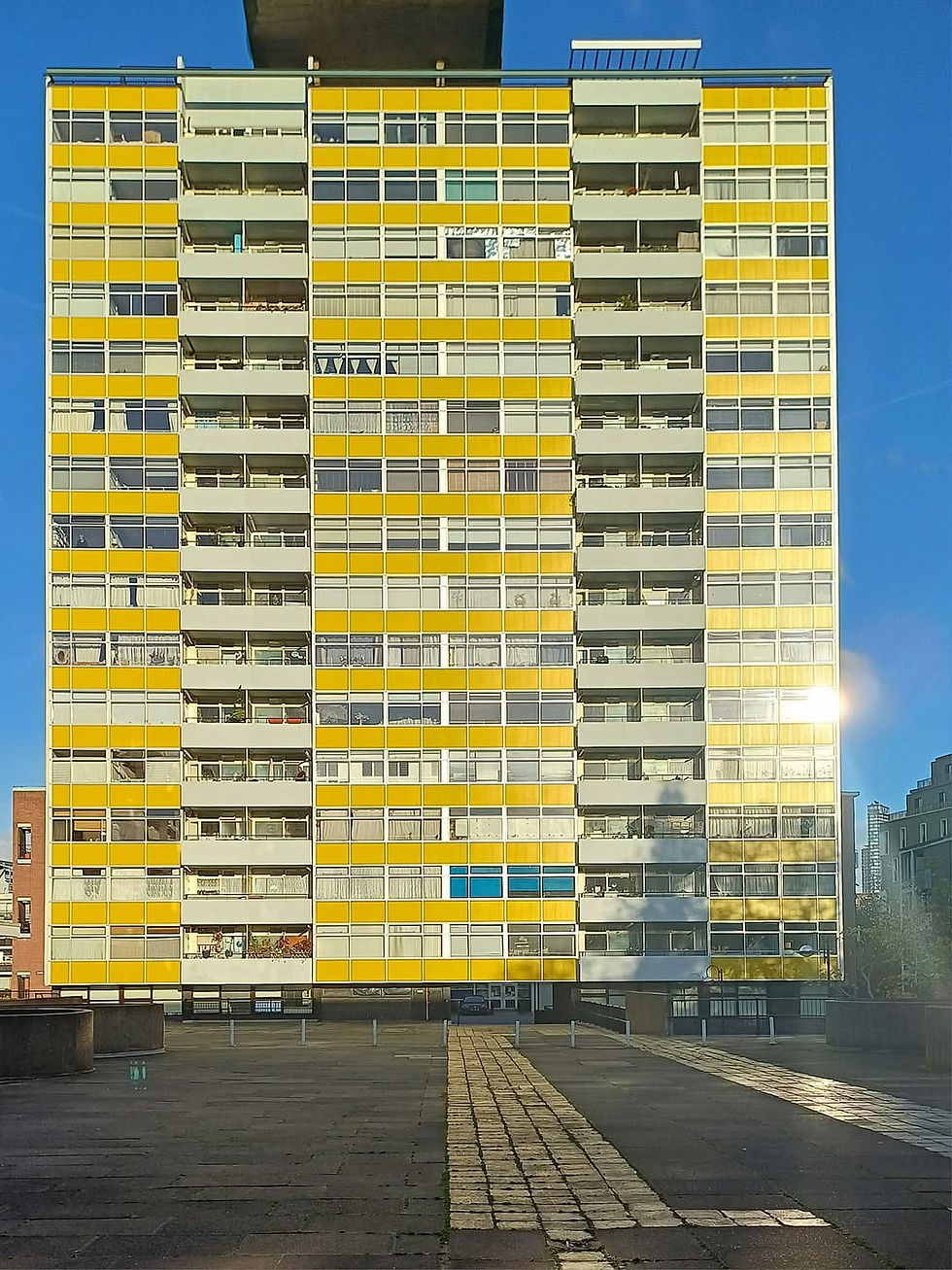
The largest building on the estate is Great Arthur House, which features a distinctive yellow and white colour scheme. At 16 storeys it was the tallest residential tower in the country when it opened. It originally had a rooftop water garden, but this is no longer open. The concrete aerofoil canopy conceals the water tank and the lift motor.
Crescent House, which follows the curve of Goswell Road and is Grade II* listed, arguably departs the furthest from Le Corbusier, with clear historic reference to the medieval and Tudor history of the City in the facades of the front of the building.


The three architects formed their partnership to take on the project after Geoffry Powell won the design competition launched by the City Corporation in 1951. He, Peter Chamberlin and Christof Bon were all lecturers in architecture at Kingston School of Art. They each submitted their own design and had agreed to join together if any one of them won the competition.

They went on to design the neighbouring Barbican Estate, also for the City of London Corporation, in the following decade.

Golden Lane, the street, has a long history. First mentioned in 1274, when a family named Goldyng or Golda lived there, it has variously been known as Goldyng Lane, Goldeslane and Golding Lane.
In John Stow’s 1598 book The Survey of London, the writer said that Golden Lane was “replenished with many tenements of poor people”. This was a characteristic that the street would struggle to shed.
The Fortune Theatre was built in 1600 between Golden Lane and Whitecross Street by actor/theatre manager Edward Alleyn, a contemporary of William Shakespeare (whose First Folio collection of plays was printed very close to the site of the Golden Lane Estate in 1623). This was outside the jurisdiction of the City of London, in the downmarket kind of area typical of playhouses at the time.

A brewery, originally Combrune’s Brewhouse, was built on the east side of Golden Lane in 1792. It was renamed the Genuine Beer Brewery under new owners in 1804. The brewery closed in 1827 and the site became a cemetery in 1833.

Known as the City Bunhill Burial Ground (not to be confused with the nearby Bunhill Fields), 18,000 nonconformists had been buried there when it closed in 1853.
By this time Golden Lane was a slum, where - according to a 19th century account - the “character of the low lodging-houses, the drinking-shops, the dancing-rooms, was bad beyond description”. The street and its many small adjoining courtyards and alleys were home to a large population of poor Irish people, including costermongers and other street traders.
In 1861, Methodist minister William James Orsman (nicknamed the Archbishop of Hoxton) founded the Golden Lane and Hoxton Costers’ Christian Mission to ease the hardships of the local community.
An 1877 scheme to improve housing in Golden Lane, for which the Metropolitan Board of Works was to provide £40,000 (more than £4 million in today’s money) fell victim to a corruption scandal.
The Cripplegate Institute opened at the southern end of Golden Lane in 1896. Bringing together historic charitable trusts and assets formerly administered by the Parish of St Giles Cripplegate, it was an educational and recreational resource for local residents and workers.
The Institute closed in 1973, but evolved into the Cripplegate Foundation, which supports projects to reduce poverty an inequality in Islington. Its former home is now offices.

The Cripplegate Institute Building is the only survivor on Golden Lane of a German fire bomb raid on the night of 29 December 1940, during World War II. The raid destroyed an area three quarters of a mile long and a quarter of a mile wide. Stretching from St Paul’s Cathedral to what was then the Borough of Finsbury (now the southern part of Islington) this was the biggest continuous area of devastation in the UK.
The Blitz destroyed the City of London’s biggest residential area, reducing the population of the Square Mile to a level that threatened its viability as a separate local authority. The Golden Lane Estate and, later, the Barbican Estate, were part of the City’s actions to rebuild the population.

The City of London Corporation bought the initial 4.7 acres for the Golden Lane Estate in 1951 and added more to bring the total to 7 acres in 1955. A further 7 acres was added during the 9 year construction period, allowing for, among other features, the swimming pool and leisure centre.
In the Golden Lane Estate and the Barbican Estate, Chamberlin, Powell and Bon left a huge architectural legacy in the northern part of the City of London, an area that is almost completely unrecognisable from its pre-World War II state.

The Barbican is grander in scale, both in its buildings and its open spaces, but the Golden Lane Estate has cleaner lines and its primary colours are more vibrant.
Click on any image to enlarge
Walks available for booking
For a schedule of forthcoming London On The Ground guided walks and tours, please click here.


Ragdoll Hit is the perfect party game, everyone ends up cracking up.
Tiny fishing is one of those games where even your worst sessions still feel productive and worthwhile.
Level Devil could easily be used to study human persistence, we just keep coming back.
Every time I beat a hard level in Level Devil, I feel like I just achieved something huge in life 😅