
The Animals In War Memorial on the edge of Hyde Park
A moving memorial to animals that took part and died in 20th century wars and conflicts.

The Animals In War Memorial is a tribute to horses, mules, donkeys, dogs, pigeons, elephants, camels, oxen, bullocks, cats, canaries and - perhaps most surprisingly - glow worms that served and lost their lives alongside British and Allied forces. As an inscription on the monument says, “They had no choice”.
It is in Park Lane, at Brook Gate, close to Speakers Corner in Hyde Park. It was created by sculptor David Backhouse, with carvers Richard Holliday and Harry Gray, and unveiled by The Princess Royal on 24 November 2004.
Walks available for booking
For a schedule of forthcoming London On The Ground guided walks and tours, please click here.
The memorial covers a large area over two levels. It features a stone wall, split into two sections either side of a narrow gap, which curves around the lower level.

Two bronze mules, carrying heavy loads, are walking across cobblestones towards steps leading through the wall.

The longer section of the wall ahead of the mules depicts, in bas-relief, animals that served in conflicts.

On the reverse of this section of wall, the stone has been chiselled away, leaving only a ghostly outline representing the animals that were lost.

Through the gap in the wall, on the higher side, a bronze dog and horse are walking across grass away from the wall, free of any burden. According to the Animals In War Memorial’s website, they represent hope for the future. They also bear witness to the loss of their comrades, as seems to be indicated by the angle of the dog’s head, turned back towards the wall.

The shorter section of the wall bears the name of the monument and the words, “They had no choice”.
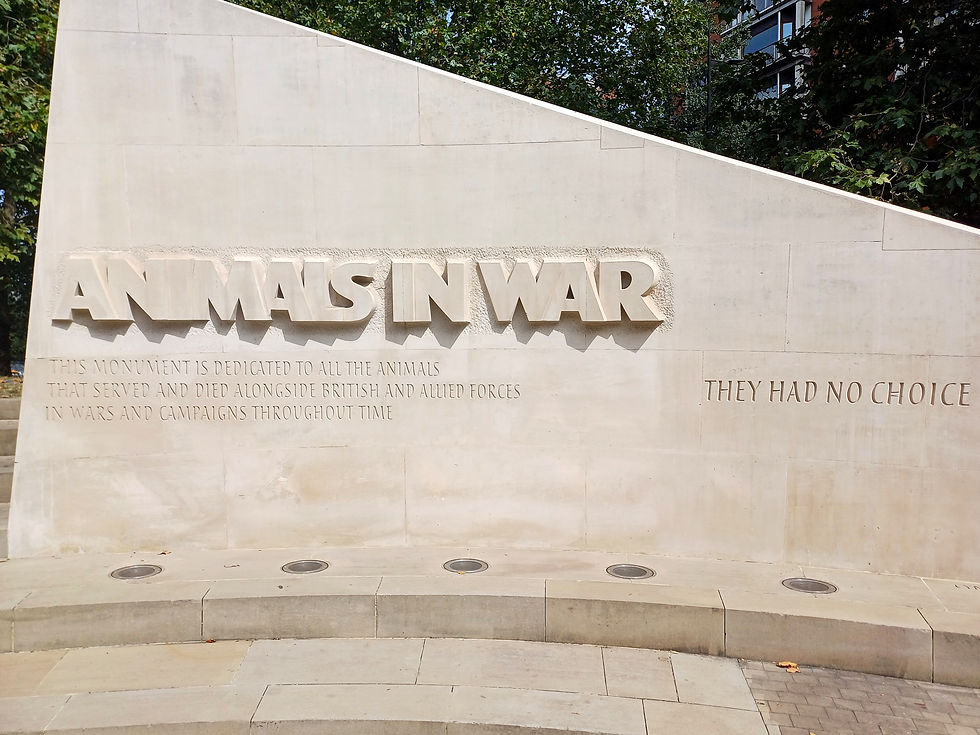
On the other side are the names of the major donors who helped to fund the memorial and the following inscription:
“Many and various animals were employed to support British and Allied forces in wars and campaigns over the centuries and as a result millions died. From the pigeon to the elephant they all played a vital role in every region of the world in the cause of human freedom. Their contribution must never be forgotten.”

The memorial’s website notes that eight million horses and “countless” mules and donkeys died in World War I due to shellfire and also due to bad weather and atrocious conditions. These animals were used to transport supplies and ammunition, with mules especially adaptable in working in extreme weather conditions in both world wars, whether the freezing mud of the Western Front or Monte Cassino, or the stifling heat of Burma, Eritrea and Tunisia.
Horses also made a contribution to the war effort at home. A police horse named Upstart was awarded the PDSA Dickin Medal - regarded as the Victoria Cross for animals - for remaining calm when a V2 flying bomb exploded less than 75 yards away, showering him and his rider with broken glass and shrapnel. The citation noted that he “was completely unperturbed and remained quietly on duty with his rider controlling traffic, etc. until the incident had been dealt with.”
Dogs carried out a range of wartime duties, including carrying messages, laying telegraph wires, mine detection, digging out bomb victims and serving on guard or on patrol.
In World War II a collie crossbreed named Rob participated in landings in North Africa and also parachuted more than 20 times, often behind enemy lines, to guard and patrol with a unit of the Special Air Service. Known as the Para dog, he was awarded the PDSA Dickin Medal and the citation declared that “his presence with these parties saved many of them from being discovered, and thereby from being captured or killed.”

Pigeons were invaluable in carrying messages when other means of communication were not an option. They could fly at speeds of a mile a minute (60mph) on missions starting on land, on ships, or on aircraft. Large numbers of pigeons served Britain in the two world wars: more than 100,000 in World War I and 200,000 in World War II.
A USA army pigeon named GI Joe became the first non-British recipient of the PDSA Dickin Medal after completing a 20 mile flight in 20 minutes, bringing a message from British 10th Army HQ that arrived just in time to prevent at least 100 Allied soldiers from being bombed by aircraft of their own side in Italy. Presented with the award at the Tower of London in 1946, the citation read, “This bird is credited with making the most outstanding flight by a US Army pigeon throughout the whole of World War II.”
The wide range of creatures that assisted troops in wartime includes glow worms. The localised blue-green light emitted by these larvae enabled solders in the trenches of World War I to read maps, letters and important communications in the dark without being seen by the enemy.
The Animals In War Memorial is, like so many features of London, hiding in plain sight. Only a short walk from Marble Arch at the western end of Oxford Street, it is an impressive, thoughtful and poignant tribute to animals who really did have no choice.

Walks available for booking
For a schedule of forthcoming London On The Ground guided walks and tours, please click here.


Comments