
Barbara Bodichon: unsung 19th century artist and women’s rights pioneer
The influential artist, educationalist, philanthropist, feminist and suffragist was ahead of her time, but is little known today.

Barbara Leigh Smith Bodichon co-founded Britain’s first women’s suffrage group and Girton College Cambridge - Britain’s first residential college for the degree level education of women. She also successfully campaigned to allow married women to own money and property.
She was writer George Eliot’s closest friend and her social circle also included feminist and suffragist Emily Davies, with whom she co-founded Girton College; Elizabeth Blackwell, the first woman to qualify as a doctor in the US; Elizabeth Garrett Anderson, the first woman to qualify as a doctor in the UK; poet Elizabeth Barrett Browning; writer Elizabeth Gaskell; and Pre-Raphaelite Brotherhood painters William Holman Hunt and Dante Gabriel Rossetti.
Barbara was first cousin to nurse and statistician Florence Nightingale. She had an aunt, Joanna Maria Smith, who married MP and barrister John Bonham-Carter, from whom the prominent family bearing his surname is descended.
Walks available for booking
For a schedule of forthcoming London On The Ground guided walks and tours (including two walks in March for Women's History Month), , please click here.
I had never heard of Barbara Bodichon (née Leigh Smith) until a recent visit to Manchester’s Whitworth Gallery, where I was struck by a pencil and chalk drawing by her, entitled A Tree Near London and dated 1849.

The rural scene depicts a gnarled tree curving over a stream flowing through open fields. Nailed to the tree are two boards bearing a message, hand written in capital letters, as follows:
NO THOROUGH FARE NO HORSES NO DONKEYS NO MEN NO WOMEN NO NOBODIES ADMITTED ANY ONE TRESSPASSING will be prosecuted
Below the signs, we see a chain hanging from the tree trunk, its loose end having apparently been broken from a post on the bank of the stream. It would seem that someone has ignored the warning and broken into this private estate.
To me the drawing seemed too modern, too free-spirited and altogether too subversive to have been created by a woman in the rigid and hierarchical early Victorian age. This prompted me to find out more about the artist. I discovered a woman who had all of these qualities and more.
Born in a village near Hastings in1827, Barbara’s family background was highly unconventional and this set the tone for her own life.
Her father, Benjamin Leigh Smith was a member of the landed gentry, a Whig MP, philanthropist and radical thinker (his father, William Smith, also an MP, was a Parliamentary reformer and campaigner for the abolition of slavery). Her mother, Anne Longden, was a milliner from Derbyshire.
Even more scandalous than being from different social classes, the couple never married. Ben Smith’s radical views included a belief that marriage was bad for women’s legal rights.
Anne died from tuberculosis in 1834 after giving birth to four more children. Ben Smith employed a local woman to look after the children at the family home in Pelham Crescent, Hastings. In spite of his wealth, he sent them to local schools. Moreover, and against the conventions of the time, he gave each child (not just the boys) the same £300 annual income when they turned 21.

An independent income meant that Barbara did not have to find a husband to support her, the fate of most women at the time, but was able to follow her own interests in education, art and women’s rights. The family had a home in Blandford Square, Marylebone (which she inherited after her father’s death), and London became the location for her to pursue these interests.
With her friend Elizabeth ("Bessie") Rayner Parkes, whom she knew from Pelham Crescent, Barbara established a progressive primary school in Paddington. After much research, they decided to set up a non-denominational school for girls and boys of all social classes.
Barbara studied art at the Ladies College in Bedford Square (the UK’s first higher education college for women) in 1849. Soon after, she formed a group to explore and promote equality for women. Known as the Ladies of Langham Place, the feminist group is considered one of the first organised women’s movements in the country.
A key focus of the group was the denial of property rights to married women, leading to Barbara’s 1854 publication Brief Summary of the Laws of England concerning Women. This cast a light on all the laws that disadvantaged married women and gave all rights over their property (including their bodies) to their husbands.
A concerted campaign to change the law included a petition drafted by Barbara that gathered more than 26,000 signatures. The petition was rejected when it was presented to Parliament in 1856, but it eventually led to the Married Women’s Property Acts of 1870 and 1882, which allowed wives legal control of their own property.
In 1857 Barbara’s pamphlet Women and Work called for equal opportunities for women in education and work, at a time when women were not allowed to go to university or to pursue most careers.
Her ideas were developed further in the English Women’s Journal, established by Barbara in 1858, and The Society for Promoting the Employment of Women, which she co-founded with fellow activist Jessie Boucherett and philanthropist Adelaide Ann Proctor in 1859.
Working with Emily Davies, a member of the Langham Place Group, who became editor of the English Women’s Journal in 1863, Barbara progressed her views on opening university education to women. A college initially established in Hitchin, Hertfordshire, was subsequently developed into Girton College, the first college for women at the University of Cambridge, in 1869 (but it was not given full membership of the university until 1948).
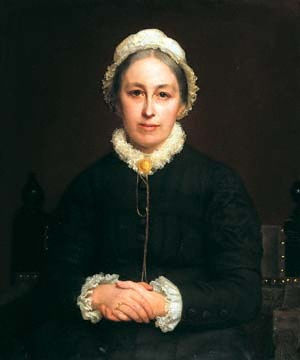
Interestingly, Girton’s two co-founders had different approaches to women’s education. Emily Davies believed the focus should be classics, maths and other traditional subjects and that discipline should be strict, in contrast to Barbara’s more radical views on the curriculum and her more liberal attitude towards discipline.
Barbara was very active in the movement for women’s suffrage – the right to vote – when more famous women’s rights campaigners such as Emmeline Pankhurst were still young children. Forming a Women's Suffrage Committee - probably the first of its kind - Barbara co-drafted a petition together with Jessie Boucherett and another campaigner, Helen Taylor, calling for votes for women, which was presented to Parliament in 1866.
The petition was taken to Westminster Hall by Elizabeth Garrett and Emily Davies, who waited for John Stuart Mill MP (Helen Taylor’s step-father) to receive it. Feeling conspicuous holding the large petition roll, Elizabeth Garrett asked the only woman in the vast hall, an apple seller, to hide the scroll under her stand. The apple woman agreed, but only after unrolling it enough to add her own signature.
Mill presented the petition as an amendment to the Reform Act, but it was defeated. Barbara continued to campaign for votes for women, publishing Reasons for and against the Enfranchisement of Women in 1869 and touring the country giving speeches. These efforts paved the way for the later (and now better known) suffragists and suffragettes.
In 1857 Barbara Leigh Smith married a French physician, Eugène Bodichon, after meeting him on a family trip to Algeria (a country where she painted more than half of her exhibited paintings). On the marriage certificate, she declared her profession as ‘artist’.
She had previously had an ill-suited love affair with John Chapman, publisher of radical journal the Westminster Review (his assistant editor and lodger was Mary Anne Evans, who later wrote novels under the pen name George Eliot).
Barbara found a much better match in Eugène, whose unconventional and liberal views fitted with hers and gave her the freedom to pursue her own interests. Her time was divided between Algeria and England.
In the same year that she married Eugène, she founded the Society for Female Artists. Now the Society of Women Artists, it still exists to promote fine art by women and to provide the opportunity for them to exhibit and sell their art.

Not long after founding the SFA she was one of a number of female artists who raised a petition to the Royal Academy School to allow access for women. It was denied, but women started to be admitted after Laura Herford was accepted on the strength of an application under only her initials. Barbara then exhibited watercolours at the Royal Academy.
Barbara had a serious illness when she was 50 years old, in around 1877. This left her paralysed and no longer able to take an active part in campaigning. She retired to Scalands Gate, the house she had designed and built in 1863 around 10 miles from Hastings in Sussex.
Nevertheless, she did not stop working for the good of others. In her later years she founded a night school for the poor in a purpose-built extension of her house.
Barbara died at her home at the age of 64 in 1891, six years after her husband Eugène.
Barbara clearly had a significant impact on 19th century Britain. She also left a lasting personal impression on people that met her.
She was remembered for her long golden hair, her good cheer and non-judgemental nature. Poet and playwright Robert Browning described meeting Barbara as a "benediction".
Jessie Boucherett referred to her as "beautifully dressed, of radiant beauty, and with masses of golden hair"
The artist Dante Gabriel Rossetti wrote to his sister Christina in 1853, ‘Ah! if you were only like Miss Barbara Smith, ... blessed with large rations of tin [money], fat, enthusiasm, & golden hair, who thinks nothing of climbing up a mountain in breeches or wading through a stream in none, in the sacred name of pigment.'
Her friend Bessie Parkes said Barbara was "the most powerful woman I have ever known."
As young women in their early 20s, Barbara and Bessie went on an unchaperoned walking tour in Belgium, Germany, Switzerland and Austria. While discussing the restrictions placed on women by men, they freed themselves from the conventional rules of women's clothing, ditching their corsets and shortening their skirts. They even wore heavy boots and blue tinted glasses. Barbara captured their spirit of liberation in a short rhyme:
Oh! Isn't it jolly
To cast away folly
And cut all one's clothes a peg shorter
(A good many pegs)
And rejoice in one's legs
Like a free-minded Albion's daughter.

After her death, The Hastings & St Leonards Observer wrote that she “gave with a free hand, and left before the recipient had time to thank her”, adding in another article that she was “a militant Radical, but she lived only to do good... Her whole life was wrapped up in trying to elevate the poor, and alleviate the sufferings of all that were downtrodden”.
Given the scale of her ambitions and achievements, it seems extraordinary that Barbara Bodichon is not better known. The picture that grabbed my attention at the Whitworth - drawn when she was only 22 - seems an appropriate metaphor for a life that aimed to change the rules and break the chains.
Walks available for booking
For a schedule of forthcoming London On The Ground guided walks and tours (including two walks in March for Women's History Month), please click here.

Comments