
London clocks: ten tickers with a tale
A selection of London’s lesser known, or lesser noticed, public clocks - time pieces that tell a tale.
Everyone knows clocks such as ‘Big Ben’ and the one at Waterloo Station, but London is teeming with lesser known clocks, or at least clocks that most people pass without noticing.
Here is my selection of ten less celebrated clocks of the capital.
Walks available for booking
For a schedule of forthcoming London On The Ground guided walks and tours, please click here.
1. ‘Black Hands’ by Chris Ofili, Hoxton Street
A few years ago, after walking past it many times without really noticing it, I was stopped in my tracks by this stunning artwork by one of the UK's leading artists. The clock faces, on four sides of a cube, have Afro heads instead of numbers, while four paintings of people in brightly coloured African dress revolve below on a second cube below. Illuminated from inside, it is best seen at night.
It stands on a pole outside Peer Gallery on Hoxton Street in Hackney, beside a small garden dedicated to Khadija Saye, an artist who worked at the gallery. She briefly met Chris Ofili, Turner Prize winning artist, at the Venice Biennale in 2017 where she'd been invited to exhibit some of her photographs. He has since talked of her "undeniably genuine, honest presence."
An emerging talent at the start of her career as an artist, Khadija and 71 other people were killed in the Grenfell Tower fire a month after that encounter. The Peer Gallery established the garden in honour of Khadija and commissioned Chris Ofili to create the art for the clock.

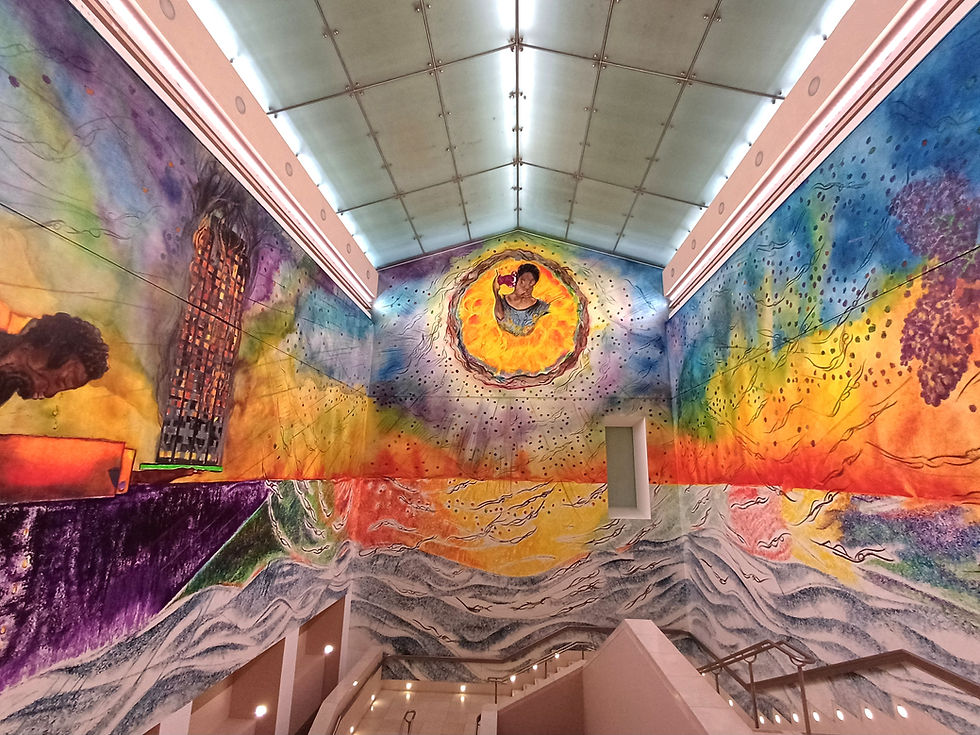
In 2023 Chris Ofili created a work called 'Requiem', painted directly on the walls above a staircase at Tate Britain. It is his response to the Grenfell Tower tragedy and features an image of Khadija Saye.
2. Angel Clock
The Angel Clock is at the intersection of City Road and Goswell Road, close to Angel tube station. It was made in 1906 or 1907 by clockmakers J. Smith & Sons, who were based nearby in St John's Square, Clerkenwell.
It served both as an advertisement for the clockmakers and as a public clock to replace an earlier time piece on this location. Smith’s donated it to the then Metropolitan Borough of Finsbury (now part of the London Borough of Islington), possibly to avoid indefinite responsibility for its maintenance, but continued to wind and maintain it for five decades. The mechanism is now electric.

On the ground, around the base of the tower, a verse from a well-known nursery rhyme is inscribed:
Up and down the City road, In and out the Eagle, That’s the way the money goes, Pop goes the weasel
3. Little Ben, Victoria Street
Another cast iron clock tower, ‘Little Ben’, stands outside the Victoria Palace Theatre at the corner of Victoria Street and Vauxhall Bridge Road. Created in 1892, its design is based on the Elizabeth Tower, the clock tower of the Houses of Parliament commonly known as Big Ben (although, strictly speaking, Big Ben is the name of the bell).

4. Underground roundel clocks
Three London Underground stations have ‘roundel clocks’ These have the London Transport roundel logo instead of numbers on the clock face and a roundel on the hour hand. They were designed by the Magneta Time Company and installed in stations on the eastern extension of the Central line in 1946. They can be seen at Wanstead station. Examples can also be seen at Bethnal Green, Redbridge and Gants Hill.
See also Design icons of the London Underground.

5. Caledonian Clock Tower
A tower that can be climbed, the clock tower in Caledonian Park is worth a visit for the panoramic vista and its 19th century clock mechanism. It was once the centre piece of the Metropolitan Cattle Market (later called the Caledonian Market), opened in 1855 by the City of London Corporation. The market replaced the livestock market that had operated for centuries at Smithfield.
The tower is built of Portland stone in an Italianate style. Its clock, with four faces, was made by John Morris of Clerkenwell, an area once very closely associated with clock and watch makers.

For more on the history and for details of tours of the tower with Islington Guided Walks, please see Caledonian Park Clock Tower: one of London's best viewing points.
6. The Daily Telegraph clock
Peterborough Court, the former Daily Telegraph building on Fleet Street, was built in the Art Deco style in 1928. It has Egyptian decorative details, including its imposing columns, reflecting a craze for Egyptian styling following the discovery of the tomb of the ancient pharaoh Tutankhamun in 1922. This influence can be seen in the building’s magnificently colourful clock, which projects over Fleet Street.

7. Arsenal Stadium clock
The clock in the old Arsenal stadium at Highbury was the idea of the club’s great 1930s manager, Herbert Chapman. Originally a 45 minute clock, counting down the minutes of each half, it was fitted at the back of the north terrace in 1930. However, the FA feared it could usurp the referee's authority and so the clock was changed to a conventional timepiece.

The clock was moved to the south terrace (then called the College End) in 1935, after which it became known as the Clock End. The original clock was placed on the outside of Arsenal’s new stadium when it opened in 2006, with a larger replica later installed inside the stadium.

For more on the history of Arsenal at Highbury, see Arsenal's Art Deco Highbury, Herbert Chapman and me.
8. Horse Guards clock
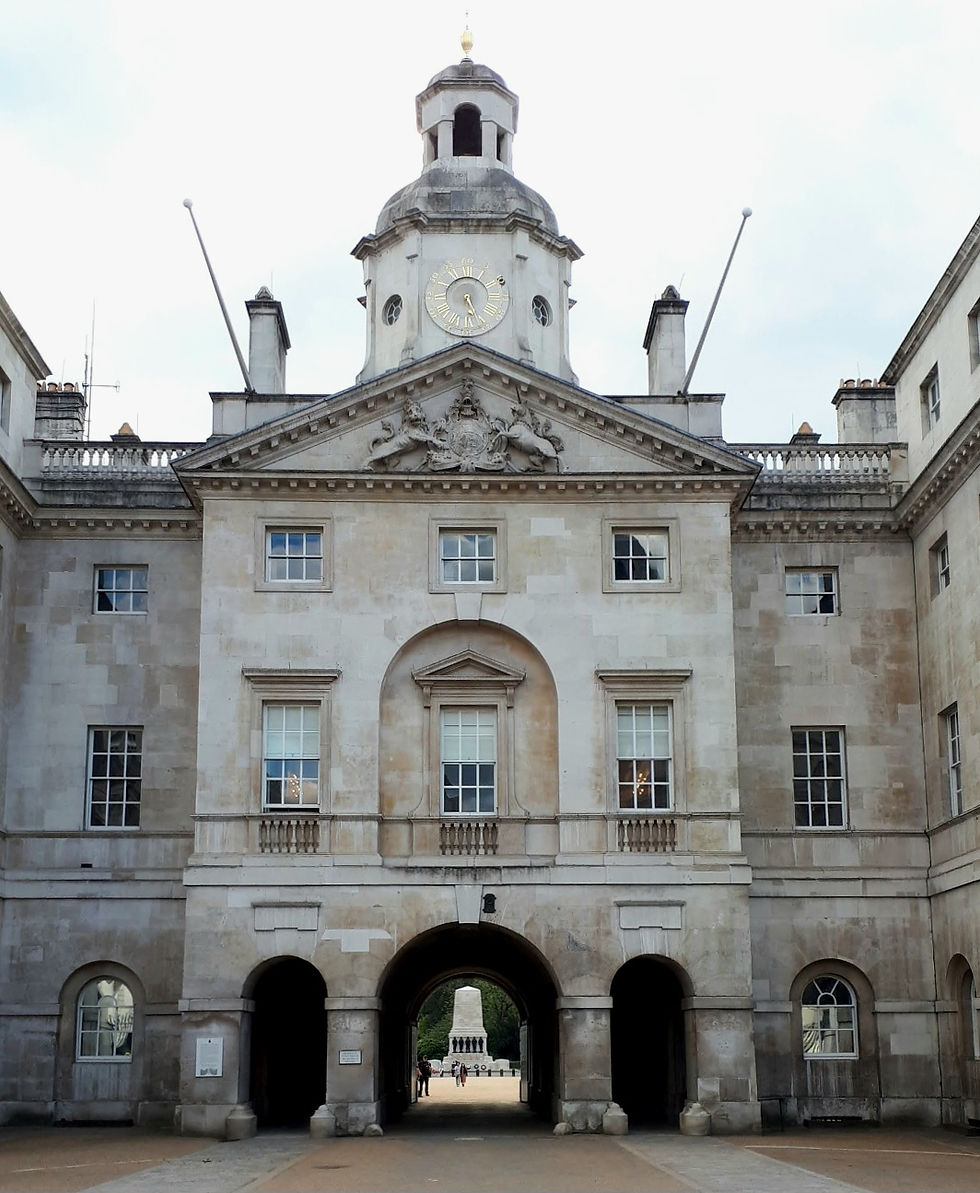
Horse Guards, on Whitehall, is notable for the brightly dressed mounted soldiers – members of the King’s Life Guard – who keep watch here.
Considerably less attention is paid to its clock. Made in 1756 and refurbished in 1816, it was the main public clock in Westminster until 1859, when the Elizabeth Tower of today's Houses of Parliament (Big Ben) was completed.
Horse Guards was originally built in the baroque style 1663, but completely rebuilt in the Palladian style in 1755. However, the clock tower retained the baroque look of its predecessor - more fussy and elaborate - leading one Victorian critic to call the building "the ugliest building in the metropolis".
Look carefully at the clock face on the Whitehall side. There is a dark mark at two o'clock, indicated by the Roman numeral II. This marks the hour when King Charles I was executed on 30 Jan 1649, outside Banqueting House on the other side of Whitehall from Horse Guards.
9. St Dunstan-in-the-West
The projecting clock on the church of St Dunstan-in-the-West is said to be the first clock in London to have a minute hand. Two figures, possibly Gog and Magog, mythical guardians of the City of London, strike the bell every quarter hour.
The clock was placed on St Dunstan’s in 1671 and removed when the church was rebuilt to allow the widening of Fleet Street in 1830-33. It was taken to the Regent's Park home of art collector Lord Hertford, where it remained for more than a century. The clock was returned in 1935 by Harold Harmsworth (Lord Rothermere), owner of Associated Press and a major figure on Fleet Street.

10. Brick Lane Mosque sun dial
OK, maybe not strictly a clock, but Brick Lane Mosque in Spitalfields has a sun dial in the pediment at the top of the wall on its Fournier Street façade.

The building has a remarkable history. It was opened in 1743 as a chapel by French Huguenot immigrants fleeing persecution in France, Protestant Dissenters who built it outside the authority of the established Church of England.
In 1809 it was rented by the London Society for Promoting Christianity Amongst the Jews, before becoming a Methodist chapel in 1819.
In 1891, the building became the Spitalfields Great Synagogue, a place of worship for Jewish immigrants fleeing persecution in Russia and Central Europe (ironic, given its 1809 occupants).
It has been a Muslim place of worship as the London Jamme Masjid since 1976, serving Bangladeshi immigrants seeking work opportunities after political upheaval in the then newly established Bangladesh.
Below the date 1743 is the Latin inscription UMBRA SUMUS (“we are shadow”).
This is a message of reflection and perspective. For me, this symbolises the building’s long history of serving diverse communities and traditions, while also providing a common reference uniting them.
Walks available for booking
For a schedule of forthcoming London On The Ground guided walks and tours, please click here.


Comments