
Thomas Becket’s lasting London legacy

The saint, a 12th century Archbishop of Canterbury, was famously murdered in Canterbury Cathedral, but he was a Londoner, born on Cheapside.

Not long after Thomas Becket’s death in 1170, a biographer wrote: "Thomas adorned Canterbury by his setting and London by his rising". After more than 850 years, his legacy continues to adorn, or at least to imprint itself on, London today.
In today’s City of London, the area of Becket’s birth, we can see many physical symbols of his life, death and legacy. Many centuries after his life was so brutally ended, his wider legacy still has an enduring and significant impact in London.
Walks available for booking
For a schedule of forthcoming London On The Ground guided walks and tours, please click here.
Becket - a brief(ish) biography
First, here is a reminder of Thomas Becket’s life story.
He was born on 21 December 1119 or 1120 on London’s Cheapside to Norman immigrant parents, Gilbert and Matilda, who came to London in around 1110. He was baptised in the local parish church, St Mary Colechurch, and named after the apostle on whose feast day he was born.

Becket’s father, who came from a humble family in Normandy, was a merchant (probably a draper) and property owner, who served a term as one of the City’s Sheriffs. Gilbert married Matilda in Normandy when the couple were around 20 and moved to England shortly after their wedding.
Thomas was educated at Merton Priory (Surrey) and at one of the City’s grammar schools and he spent a year or two at university in Paris. He returned to London after receiving news of his mother’s death.
Not long afterwards, around 1140, he took a job as an accounts clerk to a financier, Osbert Huitdeniers ('Eightpence'), who was related to Thomas and also a former Sheriff of London. The Becket family had fallen on hard times after a fire burnt some of Gilbert's properties and so Thomas’s job could supplement the household income.
A capable administrator, Thomas came to the notice of the Archbishop of Canterbury, Theobold of Bec, who recruited him as a clerk in around 1146. He rose to become the Archbishop’s right hand man and was appointed Archdeacon in 1154. This was an administrative role, but required taking holy orders.
Eventually, Archbishop Theobold recommended Becket to King Henry II for the vacant post of Lord Chancellor. He took the role in January 1155, only a month or so after Henry had been crowned by Theobold.
Becket was 13 years older than Henry, but the two hit it off and Becket became highly influential and served the King well. Thomas has been described as extravagant and ostentatious in his role as Lord Chancellor.
When the Archbishop of Canterbury died and a replacement was needed, the king decided to appoint his Lord Chancellor to be the most senior churchman in England (the two roles were often combined in the medieval period). Becket was ordained into the priesthood the day before becoming Archbishop in 1162.

Henry wanted the English Church to have less clerical independence and a weaker connection with Rome. He had been troubled by the Church's reassertion of its authority, for example in the appointment of higher ecclesiastics, the investiture of symbols and the trial of clerics convicted in Church Courts rather than in his civil courts. The king thought the appointment of his own man as Archbishop of Canterbury would solve this problem and bring the Church in line.
However, Becket chose a different path to that expected by Henry, becoming very pious and staunchly defending the Church against the king. He even resigned his position as Lord Chancellor.
The relationship between Thomas and Henry deteriorated rapidly and the Archbishop was tried and convicted on charges of contempt of royal authority and malfeasance. This lead to his fleeing to France, where he lived in exile from 1164 until 1170.

After a compromise with Henry, Becket returned to England on 1 December 1170. He arrived at Sandwich and was received with great acclaim on the road to Canterbury. However, the situation soon worsened after he was prevented from entering the City of London on the orders of Henry’s son.
The Archbishop of York and the Bishops of London and Salisbury - all royal allies - had taken part in the coronation of Henry's son and heir, the 15 year old Henry the Young King. In the period between 1138 and 1153, known as the Anarchy, before Henry II became king, civil war between rivals to the throne had ravaged England. Mindful of this, Henry now wanted to leave no doubts over the succession and so took the unusual step of ordering the coronation of his son before he became king.
However, Thomas believed that coronations were the prerogative of the Archbishop of Canterbury and was outraged that the ceremony had taken place in his absence. As a result, he excommunicated the Archbishop of York and the Bishops of London and Salisbury.
On hearing the news in Normandy, the king, in despair, exclaimed the famous words, "will no-one rid me of this turbulent priest?"
Four loyal knights took this as their cue to journey to Canterbury, where they entered the Cathedral on 29 December 1170. They confronted Thomas as he was attending vespers and hacked him down with their swords.

Canonised in 1173, St Thomas Becket was venerated in London and soon regarded as the City’s protector and its second patron saint after St Paul.
Symbols and signs of Becket in the City today
So, where can we see symbols and references to Thomas Becket in the City of London today?
Cheapside
Outside Church’s shoe shop, 90 Cheapside, a blue plaque commemorates Thomas Becket’s birth “in a house near this spot” (although it mistakenly calls him Thomas À Becket). His birthplace, where his family lived, is where Mercer’s Hall now stands on Ironmonger Lane.

In 1227 the Becket home was given to the Knights Hospitaller of St Thomas of Acre, a religious order dedicated to the family’s most famous member. An important religious site for the next three centuries, it was acquired by the Worshipful Company of Mercers after the closure of the Hospital of St Thomas under Henry VIII in 1538.
At the corner of Cheapside and Ironmonger Lane, a cast relief of the head and shoulders of a man wearing a mitre, inscribed ‘St Thomas’ is fixed to the wall at first floor level. The design replicates the badges pilgrims would wear on the walk from London to Becket’s shrine in Canterbury.
Click on any image to enlarge
Becket relief (left, based on pilgrim badge, right) at the corner of Cheapside and Ironmonger Lane
In St Mary-le-Bow church, a stained glass window (by John Hayward, 1964) on the west wall shows Becket, wearing his mitre, sitting next to St Paul, holding a sword. The design of this window reproduces London’s Mayoral seal of the 1300s, when both St Thomas Becket and St Paul were regarded as the City's two patron saints (see also: Present arms! London's portrayal in seals and heraldry).

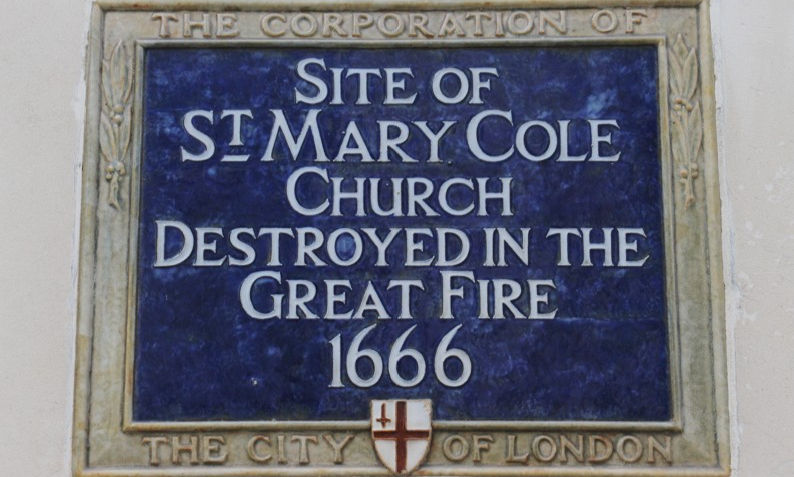
On Old Jewry, at the corner with Cheapside, a blue plaque records the former location of St Mary Colechurch, where Becket was baptised. The church was destroyed in the Great Fire of London in 1666 and never rebuilt.
St Paul’s Churchyard
In the garden on the south side of St Paul’s Cathedral, a sculpture represents Thomas at the moment of his murder in Canterbury Cathedral. It was created by Edward Bainbridge Copnall in 1970 from fibreglass resin on wire netting, with bronze pigments. The plinth recalls the steps into the choir of Canterbury Cathedral, where the four knights killed him 800 years before this sculpture was made.

Elsewhere in the City
In St Mary Moorfields, a Roman Catholic Church on Eldon Street, a wall painting to the left of a stained glass window depicts Thomas as Archbishop.

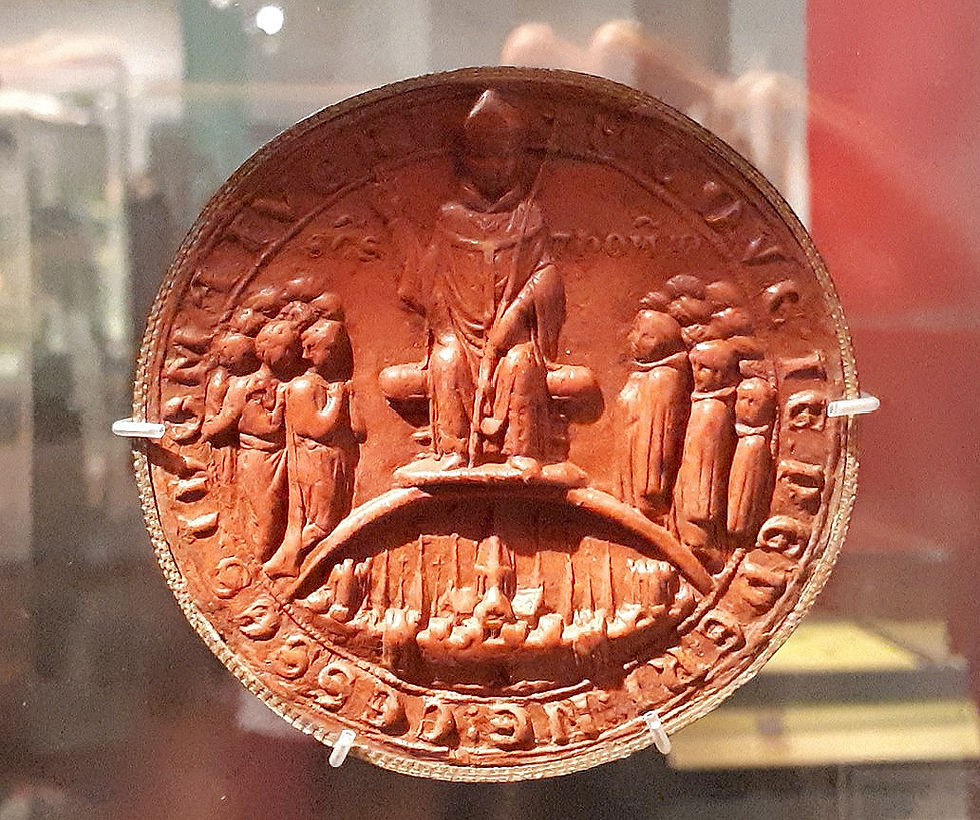
The London Museum, (due to re-open at Smithfield/Farringdon in November), has the City of London Common Seal of c.1220. It shows St Paul on the obverse and St Thomas Becket on the reverse. Becket is shown above the London skyline and flanked by a crowd of Londoners. The legend around the edge reads: ‘ME QUE TE PEPERI NE CESSES THOMA TUERI' (‘Cease not, O Thomas, to protect me who gave birth to you’).
Becket’s wider London legacy
Beyond the symbols and references to Thomas Becket in the City of London, the 12th century Londoners wider legacy in the capital is considerable. The main features of this legacy are noted below.
Description of 12th century London
Becket's clerk, a fellow Londoner, and a witness to the murder, William Fitzstephen, wrote a biography in the 1170s, in which he noted: "Thomas adorned Canterbury by his setting and London by his rising". The book also included a famous description of London, from which we gain important insights into life in the medieval City.
London's fame
After Becket’s death and canonising as a Saint, his cult spread throughout Catholic Europe. His strong association with the city of his birth, as its second patron saint, helped to promote London's reputation too.
London Bridge
The construction of the first stone London Bridge was supervised by Peter de Colechurch. He was the parish priest of St Mary Colechurch, the Becket family's local church. When Peter began to build the bridge in 1176, he dedicated its chapel to St Thomas Becket. Due to the new saint’s popularity, this helped to attract donations for building and maintaining the bridge. It was completed 1209, after Peter de Colechurch had died.

The Canterbury Tales
St Thomas Becket’s Canterbury shrine was an important site for pilgrims from all over Europe. London pilgrims started the 60 mile journey at London Bridge, where they made donations at the chapel, and then gathered at the Tabard Inn in Southwark. The travellers' stories were immortalised by Geoffrey Chaucer's book The Canterbury Tales of c1400. As the first significant work to be published in English, rather than French or Latin, the book had a major impact on English literature.
City Bridge Foundation and five of London’s bridges
Established as Bridge House Estates by Royal Charter under Edward I in 1282, City Bridge Foundation funded the upkeep of Old London Bridge (the only City of London bridge until 1769) through tolls, taxes and donations. Over time, it invested surplus funds in the acquisition of other properties and financed the construction of its replacement bridges in 1831 and 1973. It also funded the City’s newer bridges when they were added and makes charitable grants benefiting Greater London. It maintains and manages London Bridge, Blackfriars Bridge, Southwark Bridge, Tower Bridge and the Millennium Bridge.

St Thomas's Hospital, Southwark (later Lambeth)
An Augustinian priory, which included an infirmary, was originally established in the 12th century in the precinct of St Mary Overie (now Southwark Cathedral). After Becket’s death and canonisation, the infirmary acquired a dedication to St Thomas Becket. Among those tended to by the hospital were pilgrims walking from London to Becket’s Canterbury shrine and back. After a fire, it was re-established across the other side of Borough High Street, on St Thomas’ Street, in the early 13th century. During the Reformation the Hospital surrendered to Henry VIII, but it reopened under Edward VI in the 1550s with a new dedication to St Thomas the Apostle. The hospital completed a move to its current Lambeth location in 1872.
Parts of the Tower of London
During his own lifetime Becket, as Lord Chancellor, restored the Tower of London after it had been damaged in the wars of succession between 1138 and 1153. Later, in the 13th century, Edward I rebuilt much of the Tower, including a new riverside gatehouse that also included the living quarters of the royal household. The structure, which became known as St Thomas's Tower, included a chapel dedicated to Becket. During the Reformation, the river entrance under the tower was renamed Traitors' Gate, reflecting Henry VIII’s view that Becket had been a traitor to an earlier King Henry.

Becket’s legacy has endured
Becket's popularity as a saint faded in the 1400s as St George became more popular. Nevertheless, the annual ritual whereby the Lord Mayor and Aldermen rode from the Hospital of St Thomas, Becket’s birthplace on Cheapside, to St Paul's and back, where they made an offering of a penny, continued into that century.
In 1538 Henry VIII issued a proclamation that ordered the erasure of all references to St Thomas Becket throughout the realm. This led to the destruction of glass images, embroidery, statues, pictures and references in church books. The following year the City of London seal was replaced, removing the image of Becket, and the chapel on London Bridge became a house.
It is now more than 850 years after Thomas Becket’s death and almost five centuries since Henry VIII attempted to expunge him from history. Nevertheless, his legacy endures.
Walks available for booking
For a schedule of forthcoming London On The Ground guided walks and tours, please click here.


Comments