
Lord Nelson’s state funeral 220 years ago: a tale of two pickles

News of the admiral’s death reached London, via HMS Pickle, more than two months before his brandy-pickled body.

The funeral of Britain’s most celebrated naval commander took place in St Paul’s Cathedral 220 years ago (yesterday), on 9 January 1806. It was the first state funeral at St Paul’s and the grandest yet for anyone outside the royal family.
Vice-Admiral Horatio Nelson, 1st Viscount Nelson, died more than 11 weeks earlier, during the closing stages of his greatest achievement. This was his victory over the combined fleets of France and Spain in the Battle of Trafalgar on 21 Oct 1805.
Long before his funeral, and before his body had even returned home, news of Nelson’s victory and of his death at Trafalgar had to be sent to London.
HMS Pickle brings the news to England by sea…
After the battle Vice Admiral Cuthbert Collingwood, Nelson’s second in command, sent a schooner named HMS Pickle to carry despatches back to England. The schooner was commanded by Lieutenant John Richards Lapenotière (whose surname indicates his Hugenot descent).
He and his ship had observed the Battle of Trafalgar, since schooners were too small to take part, but had been involved in rescuing survivors afterwards.
Setting off from near Cape Trafalgar off the Atlantic coast of Spain on 26 October, Lapenotière was approaching the English Channel by 1 November, after a difficult voyage in bad weather. Realising that strong winds would impede HMS Pickle’s further progress up the Channel, he made landfall at Falmouth in Cornwall on 4 November.
…and by land
He then travelled 271 miles to London by post-chaise (a small carriage designed for long distance journeys at speed).
After completing the journey in 37 hours and with 21 changes of horses, Lapenotière reached the Admiralty on Whitehall at 1am on 6 November. Handing the despatches to the First Secretary to the Board of the Admiralty, William Marsden, he said, “Sir, we have gained a great victory. But we have lost Lord Nelson”.
On receiving these two items of news, King George III tearfully lamented “we have lost more than we have gained”. The Times declared “we do not know whether we should mourn or rejoice”.
For his efforts, Lapenotière was promoted to the rank of Commander.

Nelson returns in a barrel of brandy
Nelson’s body took much longer to return to England.
It might never have returned at all if it had been thrown overboard, the customary form of despatch for those killed in combat at sea. Before he died on board his flagship, HMS Victory, Nelson had asked its captain, Thomas Hardy, not to follow this custom in his case.
Vice Admiral Collingwood initially decided to send the body home on board a fast frigate. However, the crew of HMS Victory did not want their admiral to be handed over to any other vessel. They persuaded Collingwood to allow them to carry the body back to England. This highlights the high regard in which Nelson was held by men under his command.
In the absence of sufficient lead to make a coffin, the ship’s surgeon, William Beatty, decided that the best way to preserve Nelson’s corpse for the long voyage was to lower it head first into a large wooden barrel, which was then filled with brandy.
Bad weather and damage to HMS Victory meant that she only arrived at Gibraltar on 28 October, one week after the battle. Repairs were made to the ship and spirits of wine were added to the barrel.

According to legend, sailors on board the ship made a hole in the barrel and drank the brandy through a straw. The expression ‘tapping the admiral’, meaning getting a free drink from a commanding officer, or otherwise enjoying a furtive drink, is said to have its origins in this story. In fact, there is evidence of the expression’s use before the Battle of Trafalgar, but why let the truth spoil a good story?
There may be some basis of truth in the legend. Although a Royal Marine sentry had been guarding Nelson’ body, the level of brandy had dropped when the barrel was examined at Gibraltar. It was topped up with spirits of wine, which has a higher alcohol content and so was better for pickling the body.
Sailing from Gibraltar on 3 November (by which time HMS Pickle was in the English Channel and approaching Falmouth), HMS Victory arrived at Portsmouth just over a month later, on 4 December. The barrel required refilling twice more with brandy and spirits of wine.
After the ship departed Portsmouth on 11 December, heading for the Thames Estuary, the surgeon performed an autopsy on Nelson’s corpse.
He found that “the vital parts were so perfectly healthy, and so small, that they resembled more those of a youth” than of a 47 year old man. He judged the cause of death to have been a wound to the left pulmonary artery as a result of a shot from a French musket, which also damaged Nelson’s spine.
The body was then placed in a lead coffin, which had been taken on board at Portsmouth. After sheltering from bad weather at Dover, Victory arrived off the Nore (a sandbank in the Thames Estuary between Shoeburyness and Sheerness) on 23 December.
Nelson’s lying-in-state at Greenwich
At the Nore the body was transferred into a wooden coffin made from the mast of the French flagship at the Battle of the Nile, where Nelson had been victorious in 1798.
This coffin was placed into a more elaborate outer coffin and taken upstream to Greenwich on the yacht of the Commissioner of the Royal Navy Dockyard at Chatham. On the way, other vessels dipped their flags, churches rang their bells and Forts at Tilbury and Gravesend fired cannons in salute.
The coffin was held at the Royal Hospital for Seamen at Greenwich (now the Old Royal Naval College, part of Maritime Greenwich), where a three day public lying-in-state took place in the magnificent Painted Hall.
From 4-7 January 1806, an estimated 15,000 people filed past the coffin, but this was far fewer than the numbers who had queued outside, but had not been admitted due to lack of capacity.
The procession along the Thames to Whitehall
On 8 January, a wet and windy day, a large procession escorted the coffin up the River Thames from Greenwich to Whitehall Stairs. The funeral barge, originally built for Charles II, was rowed by sailors from HMS Victory.
Three other state barges followed it, carrying naval officers and heralds. The chief mourner, Admiral of the Fleet Sir Peter Parker, was on the last of these, accompanied by other senior naval officers.
There followed the royal barge, carrying representatives of the king, and barges for the lords commissioners of the Admiralty, the Lord Mayor of London and the City Corporation, the Thames Navigation Commission and City Livery Companies. A large number of smaller boats, official and otherwise, also followed the procession.


Spectators lined the banks of the Thames and crowded onto the decks and rigging of all the vessels moored along the route. Gun salutes were fired by the River Fencibles (volunteer defence units) and the cannons on the wharf at the Tower of London.
On arrival at Whitehall, Nelson’s coffin was carried by eight crewmen from HMS Victory to spend the night at the Admiralty before the funeral the next day.
Nelson’s journey to the Admiralty lasted two months and 18 days from his death at Trafalgar. News of his death had reached the same building only 15 days after the battle.

The funeral procession to St Paul’s Cathedral
On 9 January there was another grand procession, this time on land. Eight infantry battalions were represented, together with three cavalry regiments, 11 horse artillery guns, 48 sailors from HMS Victory, 48 Greenwich Pensioners and the Royal Watermen. There were 189 carriages, bearing royalty, relatives, official mourners and heralds.
Nelson’s coffin was carried in a funeral car resembling his flagship, beneath an elaborate canopy and with the Royal Navy ensign at half mast at the stern.

The route to St Paul’s, via Whitehall, Charing Cross, The Strand, Fleet Street and Ludgate Hill, was lined by soldiers of London’s volunteer units. Members of the public crowded the pavements behind them, watching with a combination of reverence and enthusiasm. Those wanting a better view of the spectacle could hire rooms in houses on the way, if they could afford the high prices demanded by the owners.
At Temple Bar, the gateway between Westminster and the City of London, the Lord Mayor and six carriages of City officials joined the procession.
Led by pipers from Scottish Highland regiments, the coffin arrived outside St Paul’s by 2pm. It only entered the cathedral at around 3pm, after mourners in the procession had taken their seats. It was carried by six vice admirals (naval officers of the same rank as Nelson).

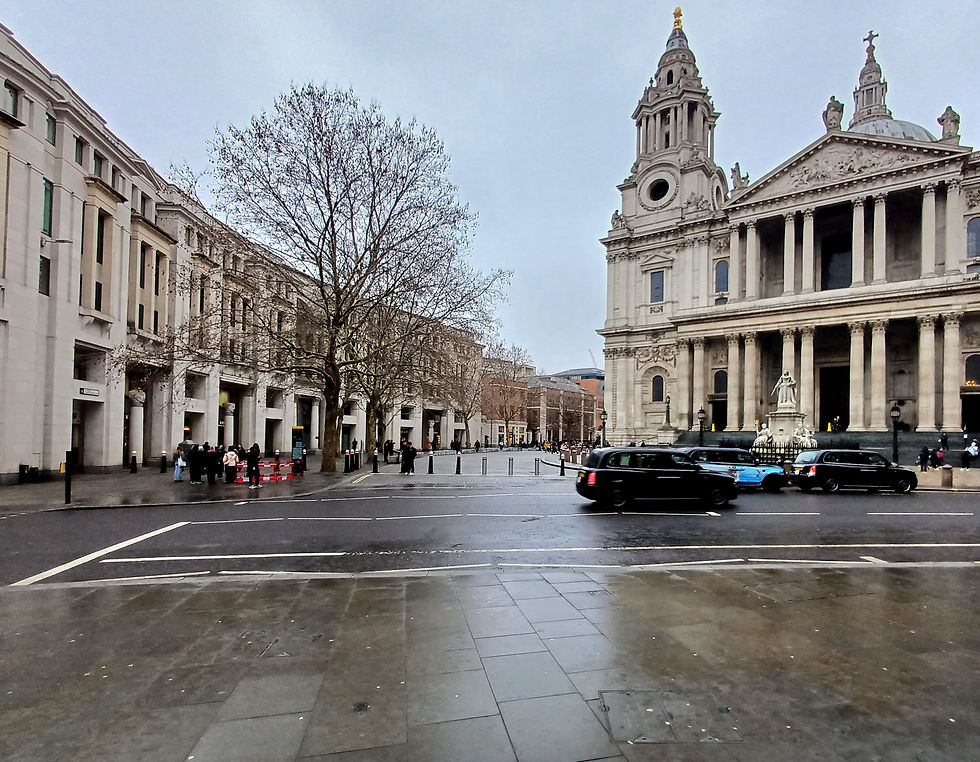
The funeral in St Paul’s
Inside, seating for 9,000 had been erected under the dome, around a chandelier specially suspended for the occasion, as the service would last well beyond the winter sunset. The 80 voice choir included singers from St Paul’s, Westminster Abbey and the Chapel Royal.
The crossing under the dome was draped with large French and Spanish flags taken from enemy ships at Trafalgar. The French commander captured at Trafalgar, Admiral Pierre-Charles Villeneuve, was also present.


Towards the end of the service, Nelson’s coffin was lowered into the crypt, while the choir sang His body is buried in peace, George Frederick Handel’s funeral anthem. Instead of dropping the naval ensign into the opening as planned, sailors from HMS Victory tore it up to keep pieces as souvenirs.
The service was over by 6pm, but the mourners did not all leave the cathedral until 9pm.
Nelson’s body was laid to rest in the crypt of St Paul’s under a black marble sarcophagus originally created for Cardinal Wolsey, Lord Chancellor under Henry VIII. After Wolsey’s downfall, death and burial in a simple pine coffin, the king considered using the sarcophagus for himself, but it had remained unused.
The scale and splendour of Lord Nelson’s funeral reflected his status as a national hero and the role his victories played in establishing British maritime supremacy, ending the threat of a French invasion.

Nelson’s Column: the most famous monument to the admiral
A number of memorials to Nelson were erected around the country in the years that followed, including one in the nave of St Paul’s, completed in 1818.
The most famous, and most prominent, of these is Nelson’s Column, which was placed in Trafalgar Square in 1843.
Next time you are in Trafalgar Square, look up and notice the direction in which the 18ft statue of Nelson is looking.
Instead of facing straight down Whitehall, his gaze is slightly off to his right, towards the Old Admiralty building, which is a short walk away on the right hand side of the street and where Nelson's body rested the night before his funeral.
Extending his line of sight by around 1,100 miles (1,770 km), he is also looking towards Trafalgar itself.

Walks available for booking
For a schedule of forthcoming London On The Ground guided walks and tours, please click here.


Comments