
Christ Church, Blackfriars Road: the story of Southwark in stained glass
- London On The Ground
- 8 hours ago
- 7 min read
A post-war church with 17th century origins has a remarkable set of 20th century secular stained glass windows.

The current church, the third on the site, is a 1950s brick-clad building of modest (although not unimaginative) external appearance.

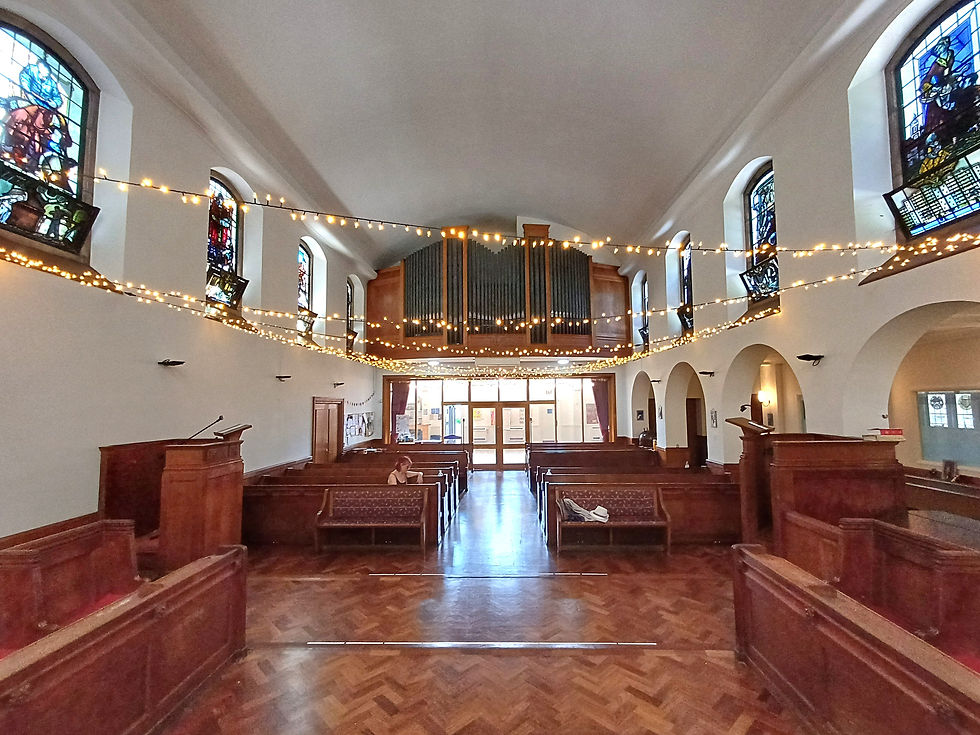
However, the church’s most engaging feature is inside, where its exceptional windows celebrate the history of the church and the surrounding area, particularly in the second half of the 20th century. They depict both ordinary lives and some well known London buildings and views.
Walks available for booking
For a schedule of forthcoming London On The Ground guided walks and tours, please click here.
The story of Christ Church starts in 1627, when a Southwark baker named John Marshall wrote his will. He provided for a new church to be built and a Rector appointed in the western part of the parish of St Saviour. Marshall died in 1631 and the church was built in 1671, with a tower completed in the 1690s. The land was given by William Angell, Lord of the Manor of Paris Garden.
The coats of arms shown below are those of John Marshall (left) and William Angell (right). They are on the end of pews inside the church.
Click on any image to enlarge




However, the church was on marshy ground and soon became unsafe. It was replaced by a second church in Italian Romanesque style in 1738, most likely designed by James Horne. It was in a similar style to the nearby St George the Martyr Southwark, which was built in 1736.

Christ Church parishioners in the 18th and early 19th centuries included writer and feminist philosopher Mary Wollstonecraft (who wrote A Vindication of the Rights of Women), her daughter Mary Shelley (who wrote Frankenstein) and the Rennie family of engineers (John Rennie the Elder and his sons Sir John Rennie, who rebuilt London Bridge, and George Rennie).
The churchyard was closed to burials in 1856 and was re-opened as a public garden by the Metropolitan Public Gardens Association in 1900. The philanthropist John Passmore Edwards donated a public drinking fountain, which is still in working order.

The 18th century Christ Church was very badly damaged by aerial bombing during the Blitz in World War II, in particular during a fire bomb raid on 17 April 1941. The blazing church cross tumbled into the churchyard and scorched the grass. This is now marked by paving stones in the shape of a cross.

The third Christ Church was designed by R. Paxton Watson and Barry Costin of Reigate and consecrated on 7 December 1959.

The new church has a tower at its east end, at the base of which is the main entrance, giving it greater prominence from Blackfriars Road. The building’s neo-Georgian brick exterior hides a concrete frame, while stone dressings and a barrel vaulted copper-clad roof also provide visual interest.

There is a church hall attached to the western end of the church, entered from the outside through doors at its southern end (as well as through internal glass doors from the nave of the church). The wall above these external doors features a statue of Christ and four stone medallions (representing Saints Matthew, Mark, Luke and John, the writers of the four gospels), which had been added to the second church in 1890 and were salvaged from the bomb damage.

Inside, the church retains its parquet floors, wooden pews, pulpits and communion rail from 1959.

The real treat of Christ Church is to enter the building and to enjoy the stained glass windows, the work of two different phases.
Frederick W Cole (1908-1998), assisted by Kenneth G. Bunton (d. 2014), created the windows above the nave and chancel in 1959-60, while John Lawson (1932-2009) was responsible for the windows at ground level in the north aisle in 1984-85 (the 25th anniversary of the post-war church).
The 1959-60 windows in the nave and chancel, by Frederick Cole (assisted by Kenneth Bunton)
None of Frederick Cole’s ten windows in the nave depict saints or religious scenes. Rather, they represent trades, crafts, industries and people in the history of Southwark and the River Thames. Each consists of a larger image forming the upper part of the window and a smaller image in the bottom section.

Much of the following information and descriptions of the Frederick Cole windows comes from Historic England's Official Listing of Christ Church (it was Grade II listed in 2010).
North Side (west to east)
1. Top: two charwomen in 1950s dress with mop and bucket, one looking out of a window towards St Paul's dome. Bottom: other women in 1950s dress in a London Transport bus stop queue and a Routemaster bus. Note the signature of K G Bunton in the fascia of a shop, to the left of the bus.
Click on any image to enlarge

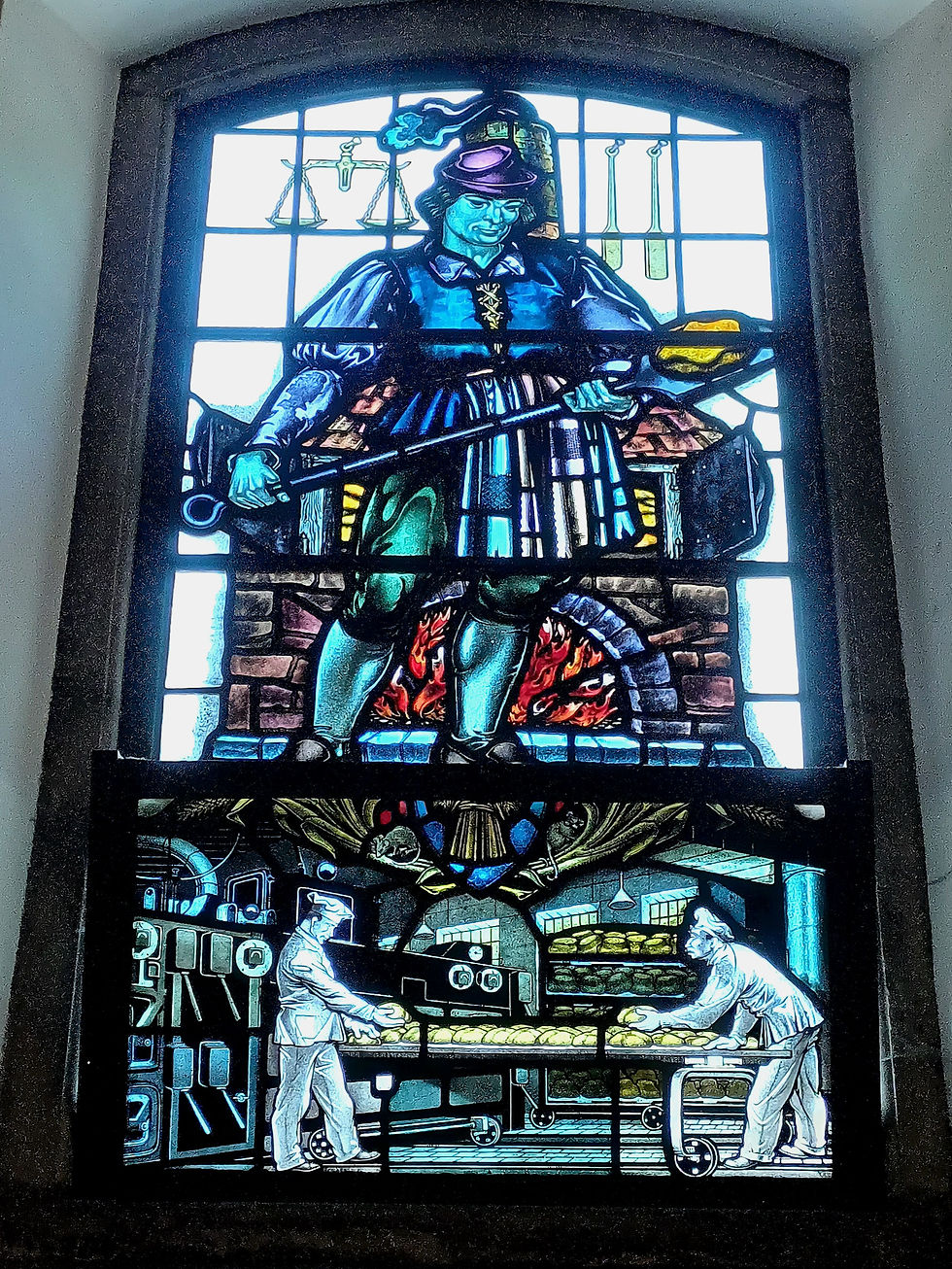
2. Top: a baker in historical dress removing bread from a bread oven. Bottom: 1950s bakers at work with industrial-sized ovens, in a factory setting.
3. Top: carpenters at work assembling a doorframe with a large seven-storey building under scaffolding in the background; the workers wear C20 clothes. Bottom: a 1950s building site showing labourers mixing cement and shovelling sand.

4. Top: a woman in historical dress carrying a basket accompanied by a boy (with ball) and a girl (with doll). The tower of Christ Church and the houses of old Southwark can be seen in the background (from a print of c.1800). Bottom: a nine-storey housing block, built in 1958 on the north side of nearby Nelson Square (viewed from Union Street).

5. Top: a suited utilities worker, with a panel of dials and three telephones against a background scene of electricity pylons leading across hills and woodland. Bottom: Bankside power station (now the Tate Modern) viewed from the south with St Paul's Cathedral beyond.

South Side (west to east)
6. Top: a man and a woman in 1950s dress in an office, with other clerical staff, a filing cabinet, a desk calendar, and a typewriter in the background. Bottom: an office scene, with clerical workers at desks with typewriters or telephones.
Click on any image to enlarge

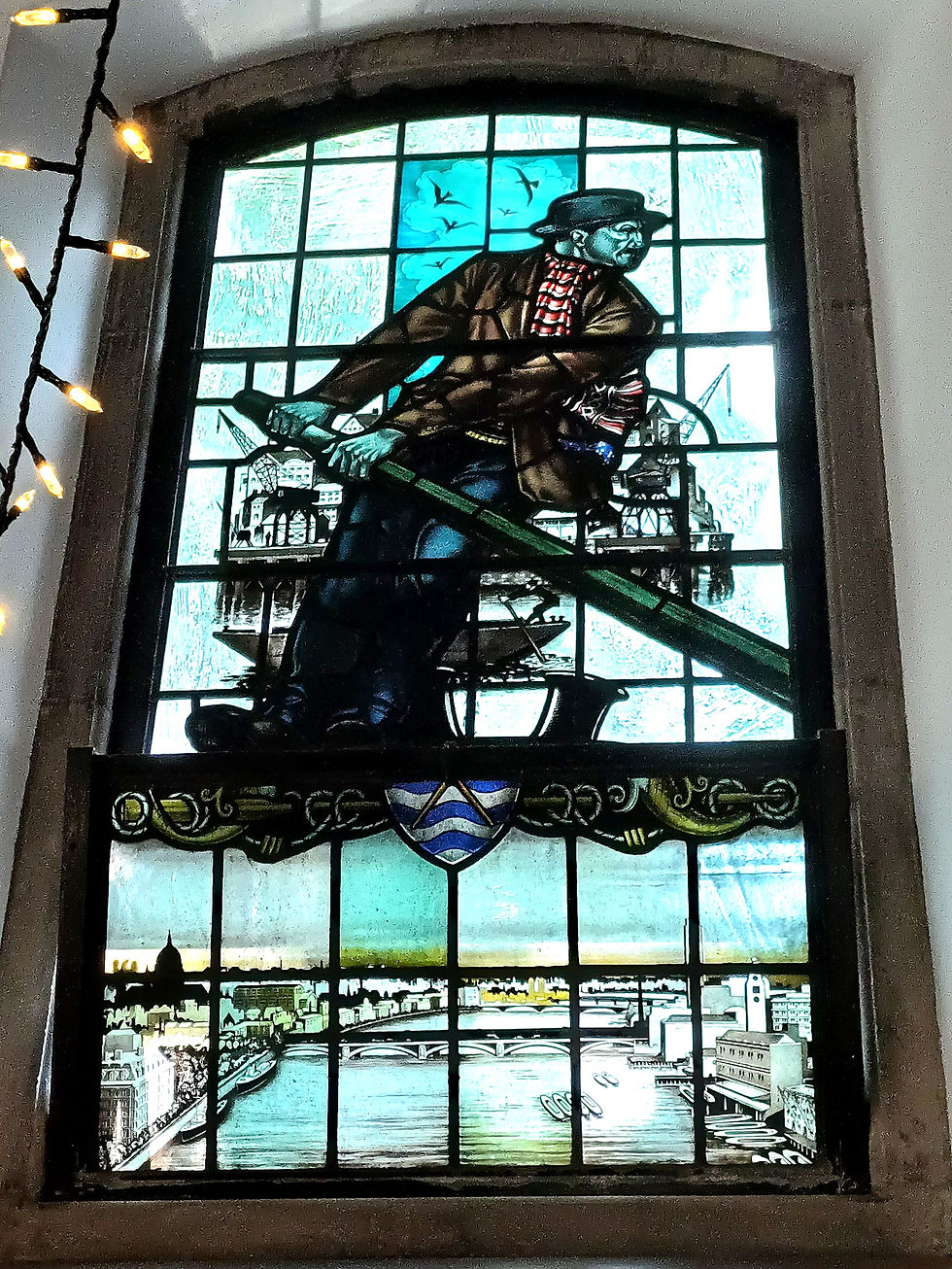
7. Top: lighterman on the Thames with cranes and wharfs behind. Bottom: a panoramic view of the river Thames, showing St Paul's Cathedral and Blackfriars Bridge.
8. Top: a printer in historical dress with his apprentice in front of a traditional printing press. Bottom: workers in a 1950s printing factory.

9. Top: goods for brewing being weighed in scales. Bottom: brewers loading ingredients into a mash tub and a copper.

10. Top: a supervisor holding a plan and callipers oversees a worker at a milling machine, representing engineering. Bottom: two men manufacturing a crankshaft on a lathe.

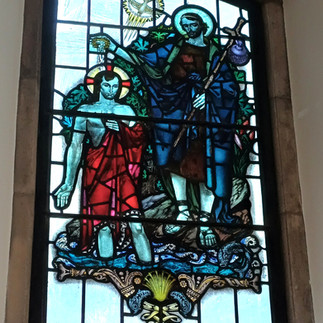
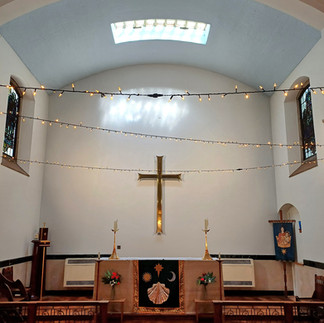
Frederick Cole also created two windows in the chancel, either side of the altar. They depict Baptism (left) and the Eucharist (right) and are the only wholly religious-themed windows in the church.
Click on any image to enlarge




The 1984-85 windows in the north aisle, by John Lawson
John Lawson’s windows of 1984-85 include images related to the history of Christ Church, as well as businesses that had a local presence (and who gave money to fund the windows). The more commercial, business-oriented images are balanced with themes such as trade unions, community and church organisations and aiming for a more egalitarian society.
One of the windows refers to the South London Industrial Mission, which was founded in 1952 and moved to Christ Church in 1967. It was part of a post-war movement, which emerged from the work of factory chaplains during World War II, to take the Christian faith into workplaces, schools and other organisations.
Unlike the earlier windows, many of the Lawson windows include text to help the viewer.
1. Left: Blackfriars Settlement, a community organisation in North Southwark. Right: Christ Church 25th anniversary commemoration.
Click on any image to enlarge

2. Left: James Adam & Sons, door spring manufacturers, which celebrated its 100th anniversary in 1984. Note the company’s premises and St Paul’s Cathedral in the background. Right: ‘Ratione vique (by reason and by force)’. Note the river and City skyline. I am not sure of the meaning of this window.

3. Left: ‘Unity is strength’, commemorating trade unions, advocating rights for ‘young, women, blacks, unemployed, handicapped, low paid, overworked’ and the ‘Duties of wealth creation: education, renewing technology, co-operative productivity, health and safety, developing democracy’. Right: ‘Jubilee oikoumene’ in male and female symbols with images of Adam and Eve. ‘Oikoumene’ is from Greek, meaning ‘the inhabited world’. It can also refer to the Christian Church united as a whole.

4. Left: Sea Containers Ltd, shipping company whose headquarters were nearby on the south bank of the Thames (the building is now a hotel). Right: Kirkaldy Testing Works, based at 99 Southwark Street and now a museum.

5. Left: J. Sainsbury, the supermarket chain whose Stamford House headquarters was nearby from the 19th century until 2001 (building now demolished). Right: Lloyds Bank, which built a data centre in Sampson House, a Brutalist building in nearby Hopton Street (now demolished).

6. Left: The Diocese of Southwark, featuring a view of Christ Church on its 25th anniversary. Right: South London Industrial Mission, which moved to Christ Church in 1967. Both windows include a depiction of the River Thames.

7. Left: Coat of arms of John Marshall, whose legacy established the first Christ Church, and image of Marshall House in Newcomen Street, Southwark, where Marshall’s Charity was based from 1853 until 1967 (when it moved across the road to a modern building). John Marshall lived in Newcomen Street in the 17th century. Right: Coat of arms of Stamford, Lincolnshire, and image of All Saints Church, Stamford, which was John Marshall's place of origin.

8. Left: Southwark/Southwark Cathedral. Right: Coat of arms of William Angell, Lord of the Manor of Paris Garden, who gave the land on which Christ Church was built, and an image of the second church, built in 1737.

Many of the trades, crafts, industries, businesses and buildings depicted in the stained glass windows of Christ Church have disappeared. As a result, the remarkable windows not only have considerable artistic merit, but they also provide an important historical record of a lost Southwark.
For a short Pathé News film clip of Christ Church, which looks at its windows, please click below.
Walks available for booking
For a schedule of forthcoming London On The Ground guided walks and tours, please click here.


Comments